Have you ever spent hours reading a textbook or watching a tutorial, only to realize you can't recall the key ideas? The problem isn't your intelligence—it's your method.
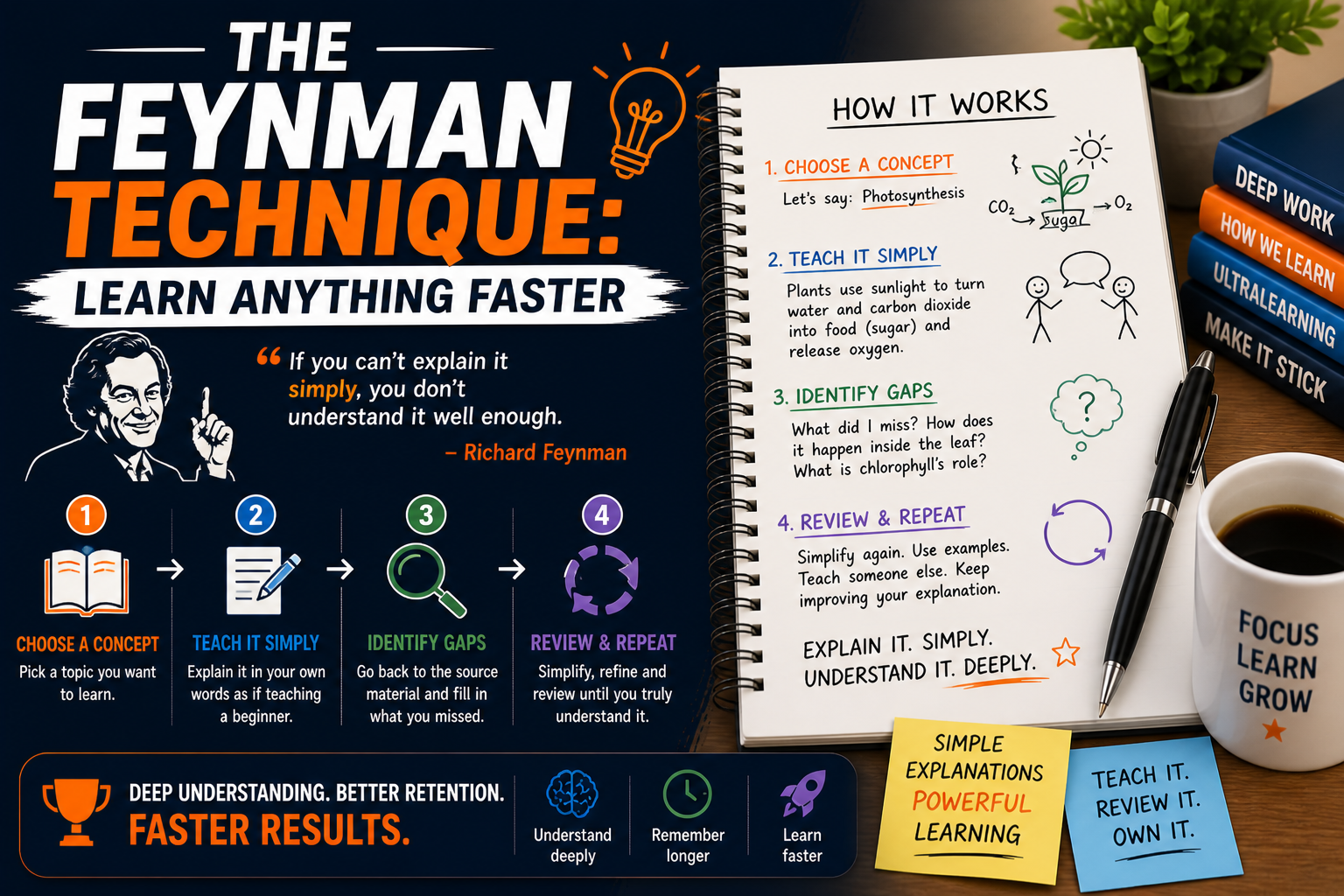
Enter the Feynman Technique, a powerful mental model for rapidly learning any subject. Named after the Nobel Prize-winning physicist Richard Feynman, this approach is less about memorization and more about genuine understanding. It’s a simple, four-step process that forces you to confront your knowledge gaps and solidify information in your mind by explaining it in the simplest terms possible.
Whether you're a student tackling a difficult exam, a professional needing to master a new skill, or simply a curious mind eager to learn, this technique can fundamentally change the way you absorb and retain information. It moves you from a passive observer to an active participant in your own education.
Who Was Richard Feynman, "The Great Explainer"?
Richard Feynman (1918-1988) was more than just a brilliant theoretical physicist. His work on quantum electrodynamics earned him a Nobel Prize in Physics in 1965, and he was a pivotal figure in the Manhattan Project. Yet, alongside his scientific achievements, Feynman was renowned for his extraordinary ability to make deeply complex ideas understandable to almost anyone.
This reputation as "The Great Explainer" wasn't an accident. Feynman had an insatiable curiosity and believed that if you couldn't explain something simply, you didn't truly understand it. His learning method, which came to be known as the Feynman Technique, was born from this philosophy. It was the same process he used to deconstruct physics problems that he also used to master everything from playing the bongo drums to cracking safes.
The Core Principle: If you can't explain a concept in simple terms to a child, you haven't mastered it yourself. This forces you to move beyond jargon and confront the core of the idea.
Why the Feynman Technique Is So Effective
The technique's power lies in its basis in cognitive science. Traditional studying often involves passive review—rereading notes or highlighting text. While this feels productive, it creates an "illusion of competence." Your brain recognizes the material but hasn't necessarily encoded it for recall. The Feynman Technique disrupts this by forcing active recall, the act of retrieving information from memory, which is proven to build stronger neural pathways.
When you attempt to explain a topic in your own simple words, you immediately discover where your understanding is weak or fuzzy. These are the knowledge gaps that passive studying misses. By identifying and filling these gaps, you build a solid and durable foundation of knowledge. It’s the difference between knowing the name of a thing and truly knowing the thing itself.
Beyond Studying: Real-World Applications
The utility of the Feynman Technique extends far beyond the classroom. Professionals of all stripes can leverage it to accelerate their growth and improve communication. A software developer can use it to understand a new programming language, a marketer can use it to grasp the nuances of a new analytics platform, and a manager can use it to prepare for a critical presentation.
Consider a sales executive who needs to sell a complex software product to a non-technical client. By using the Feynman Technique, they can practice explaining the product's benefits without resorting to confusing technical jargon. This process not only deepens their own product knowledge but also equips them with the simple, powerful analogies needed to close the deal.
"I was struggling to pass a certification exam for months. I read the book cover-to-cover three times but kept failing. Using the Feynman Technique to explain each chapter out loud made me realize how much I didn't truly understand. It was a game-changer; I passed on my next attempt."
How to Use the Feynman Technique: A 4-Step Guide
Common Pitfalls and How to Avoid Them
The most common mistake is being dishonest with yourself. It's easy to gloss over a fuzzy part of your explanation, assuming you "basically" know it. You must be rigorous. If your explanation isn't crystal clear, that's a red flag. Another pitfall is using complex vocabulary or analogies that your "student" (even an imaginary one) wouldn't understand. This is a form of hiding behind jargon. Always push for a simpler, more foundational explanation.
The Simplicity Test: If your explanation relies on vocabulary or analogies your audience wouldn't know, you haven't simplified enough. Go back and refine the core idea until it stands on its own.
Unlock Your Learning Potential
Let our writers apply advanced techniques to make your content unforgettable.