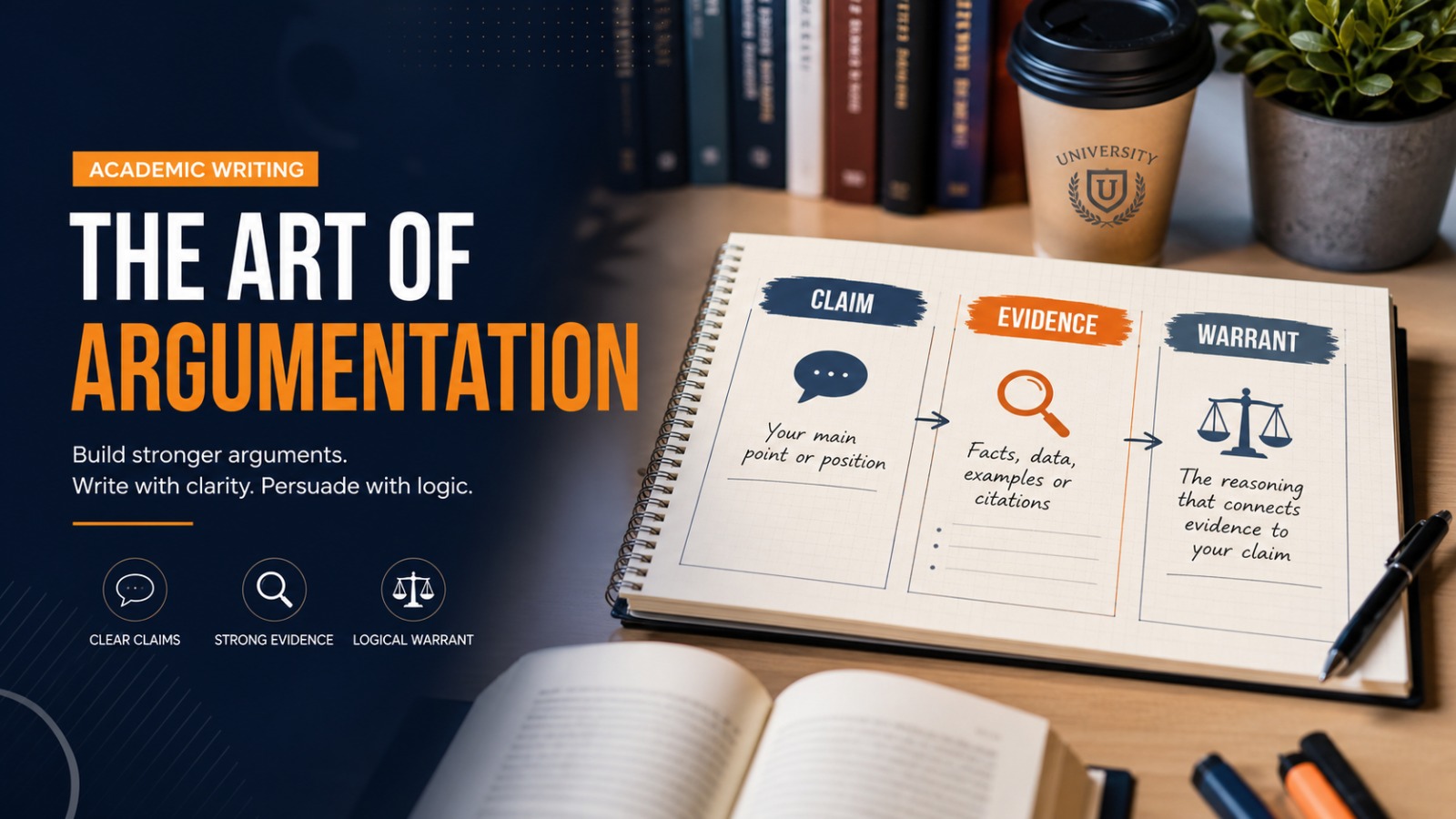
ACADEMIC WRITING
The Art of Argumentation: Build Strong Essays with Claim, Evidence & Warrant
Stop writing weak paragraphs. Learn the exact structure that turns opinions into persuasive academic arguments.
Many students have great ideas but lose marks because their reasoning is incomplete. The claim-evidence-warrant framework fixes that by giving every paragraph a clear point, proof, and logic.
Argumentation is not about sounding aggressive. It is about proving your point in a way your reader can follow and trust. The claim-evidence-warrant model helps you do exactly that. First, make a clear claim. Then support it with solid evidence. Finally, explain why that evidence actually proves your point. That final step, the warrant, is where most students struggle, and where top students separate themselves.
Whether you are writing essays in literature, history, sociology, law, or political science, mastering this structure improves clarity, credibility, and grades. Once you learn it, every paragraph becomes easier to plan and faster to write.
3
Core elements in a high-scoring argument paragraph
2x
Clearer reasoning when warrant is explicitly stated
10+
Minutes saved per paragraph with a repeatable structure
What Is a Claim-Evidence-Warrant Structure?
The claim-evidence-warrant model is a simple argument framework used in academic writing and debate. It helps transform a statement into a complete argument.
Claim: Your main point or position.
Evidence: Facts, examples, data, or quotations that support the claim.
Warrant: The reasoning that connects the evidence back to the claim.
Key Writing Insight: Evidence alone is not enough. Your warrant explains why the evidence matters and how it proves your claim.
Need Help Structuring Your Essay?
Our expert academic writers can help you build clear, citation-ready arguments.
Step 1: Write a Precise, Arguable Claim
A strong claim is specific and debatable. It should make a position clear enough that someone could disagree with it.
Weak claim: Social media affects students.
Strong claim: Excessive social media use reduces student concentration during independent study sessions.
Good claims avoid vague language and tell the reader exactly what will be argued.
Step 2: Support the Claim with Relevant Evidence
Evidence is your proof. Use credible research, class texts, historical examples, or direct data. The stronger the source, the stronger your paragraph.
Best evidence types include:
✓
Research Findings
Peer-reviewed studies and academic publications add authority.
✓
Textual Evidence
Direct quotations and close analysis from course readings strengthen interpretation.
✓
Statistics & Reports
Numbers can clearly demonstrate trends, impact, or scale.
✓
Case Examples
Real-world examples make your argument concrete and practical.
Step 3: Add the Warrant (Most Important Part)
The warrant explains the logic: why does this evidence prove your claim? Without a warrant, your paragraph feels like disconnected facts.
"I used to add quotes and assume the reader would understand my point. Once I started writing explicit warrants, my arguments became much stronger and my marks improved."
— Final-Year University Student
Quick Warrant Formula: This evidence supports my claim because ________.
A Full Example in One Paragraph
Claim: Universities should provide first-year writing workshops for all new students.
Evidence: Departments that introduced mandatory writing labs reported higher pass rates in core essay-based modules.
Warrant: If targeted writing support improves assignment quality and pass rates, then mandatory workshops are an effective strategy for improving academic outcomes.
Build Strong Arguments in 4 Simple Steps
1
State Your Claim
Write one clear sentence with your exact position.
2
Add Evidence
Use one high-quality source, quote, or statistic.
3
Explain the Warrant
Show how your evidence logically supports the claim.
4
Close with Impact
Explain why this point matters in the bigger discussion.
Common Mistakes to Avoid
✘ Making claims too broad or obvious.
✘ Using evidence without analysis.
✘ Assuming the reader will connect the logic for you.
✘ Writing summaries instead of arguments.
✘ Using weak or non-academic sources for major claims.
Claim vs Evidence vs Warrant: Quick Comparison
The claim tells us what you believe. The evidence shows what supports it. The warrant explains why that support proves the claim. When all three are present, your paragraph is persuasive, complete, and academically rigorous.
The Bottom Line: If your evidence is strong but your warrant is missing, your argument is still weak. Always connect proof to point explicitly.
Write Arguments That Actually Convince
Use claim-evidence-warrant in every body paragraph to improve clarity, coherence, and grading outcomes.