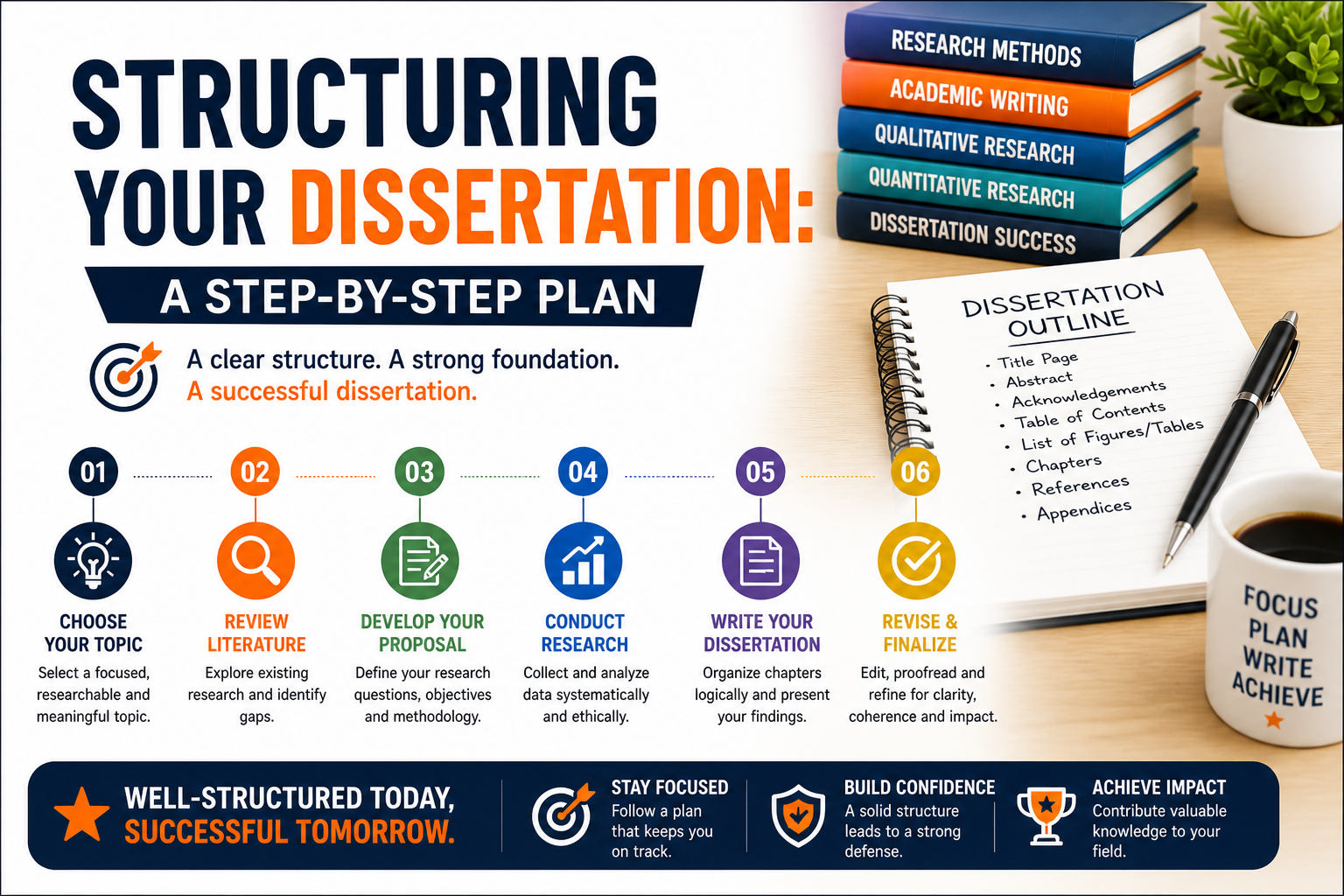
The journey to a doctorate is a marathon, and a solid dissertation structure is your roadmap to the finish line. Without it, even the most brilliant research can get lost in a sea of disorganized thoughts.
Drafting a dissertation is arguably the most challenging and complex academic task a student will ever undertake. Its sheer scale demands meticulous planning and a coherent framework to hold it all together. A logical structure does more than just organize your ideas; it demonstrates your ability to think critically, present a sustained argument, and adhere to the rigorous conventions of scholarly work. It’s the blueprint that transforms years of research into a compelling, readable, and defensible academic document.
While specific requirements can vary between universities and disciplines, most dissertations follow a conventional chapter-based format. This guide will walk you through this tried-and-true dissertation structure, providing a clear blueprint from the initial proposal to the final conclusion. Following this plan will help you navigate the writing process efficiently and ensure your final document is polished, professional, and persuasive.
The Foundation: Title, Abstract, and Introduction
These initial components set the stage for your entire dissertation. Your title page, acknowledgments, and table of contents are formalities dictated by your university. The Abstract, however, is your first critical piece of writing. It is a concise, powerful summary (typically 150-350 words) of your entire project: the research problem, methods, key findings, and main conclusions. It’s often the last thing you write but the first thing your committee reads, so it must be perfect.
The Introduction (Chapter 1) is where you grab your reader’s attention and establish the significance of your research. Here, you introduce the research topic, provide background context, and clearly articulate the research problem or gap in knowledge your work addresses. This chapter must state your specific research questions, aims, and objectives, and often concludes with a brief outline of the dissertation’s structure, providing a roadmap for the reader.
A Winning Introduction: Your introduction must hook the reader, clearly state your research problem and questions, and provide a roadmap of the chapters to come. It justifies why your research matters.
Building on Taller Shoulders: The Literature Review
The Literature Review (Chapter 2) is a critical survey and synthesis of the existing scholarly work relevant to your topic. It is not simply a summary of one source after another. Instead, your goal is to analyze, critique, and connect ideas from key texts to identify themes, debates, and unresolved questions. This chapter demonstrates your deep understanding of the academic conversation you are entering.
By mapping out the existing terrain, you create the intellectual space for your own research. A successful literature review logically leads the reader to the research gap that you identified in your introduction. It justifies your study by showing how it will address that gap, whether by challenging an existing theory, exploring a new context, or using a novel methodology. This chapter proves that your research is original and necessary.
The Blueprint: Your Research Methodology
The Methodology (Chapter 3) is the practical core of your dissertation. It provides a detailed account of exactly *how* you conducted your research. The primary goal of this chapter is to demonstrate that your research methods are sound, rigorous, and appropriate for answering your research questions. It must be written with enough clarity and detail that another researcher could, in theory, replicate your study.
Key components include your research design (e.g., experimental, correlational, qualitative case study), your participants or data sources, the instruments or tools used for data collection (e.g., surveys, interviews, archives), and the procedures for data analysis. Crucially, you must also provide a justification for each choice, explaining why the selected methods are the best fit for your research aims over other alternatives.
"I was completely lost in my data. The team at WritersHubUS helped me structure my results and discussion chapters in a way that finally made sense. It was the breakthrough I needed to move forward and finally finish."
Our Simple 4-Step Process for Dissertation Success
The Core Findings: Results and Discussion
The Results chapter (Chapter 4) and Discussion chapter (Chapter 5) are where you present and interpret your findings. The Results chapter is a straightforward, objective presentation of your data. You report what you found without interpretation or speculation, often using tables, charts, and graphs to illustrate findings, followed by descriptive text. The Discussion chapter is where you make sense of these results. You interpret what they mean, explain their significance, and connect them back to the literature review and your initial research questions. This is where you state whether your hypotheses were supported and discuss any unexpected outcomes.
Results vs. Discussion: The Results chapter presents *what* you found, using tables and figures without interpretation. The Discussion chapter explains *what it all means* in the context of your field.
Ready to Build a Flawless Dissertation?
Don't let structure stand in the way of your doctorate. Our expert team is ready to help you craft a dissertation that shines.