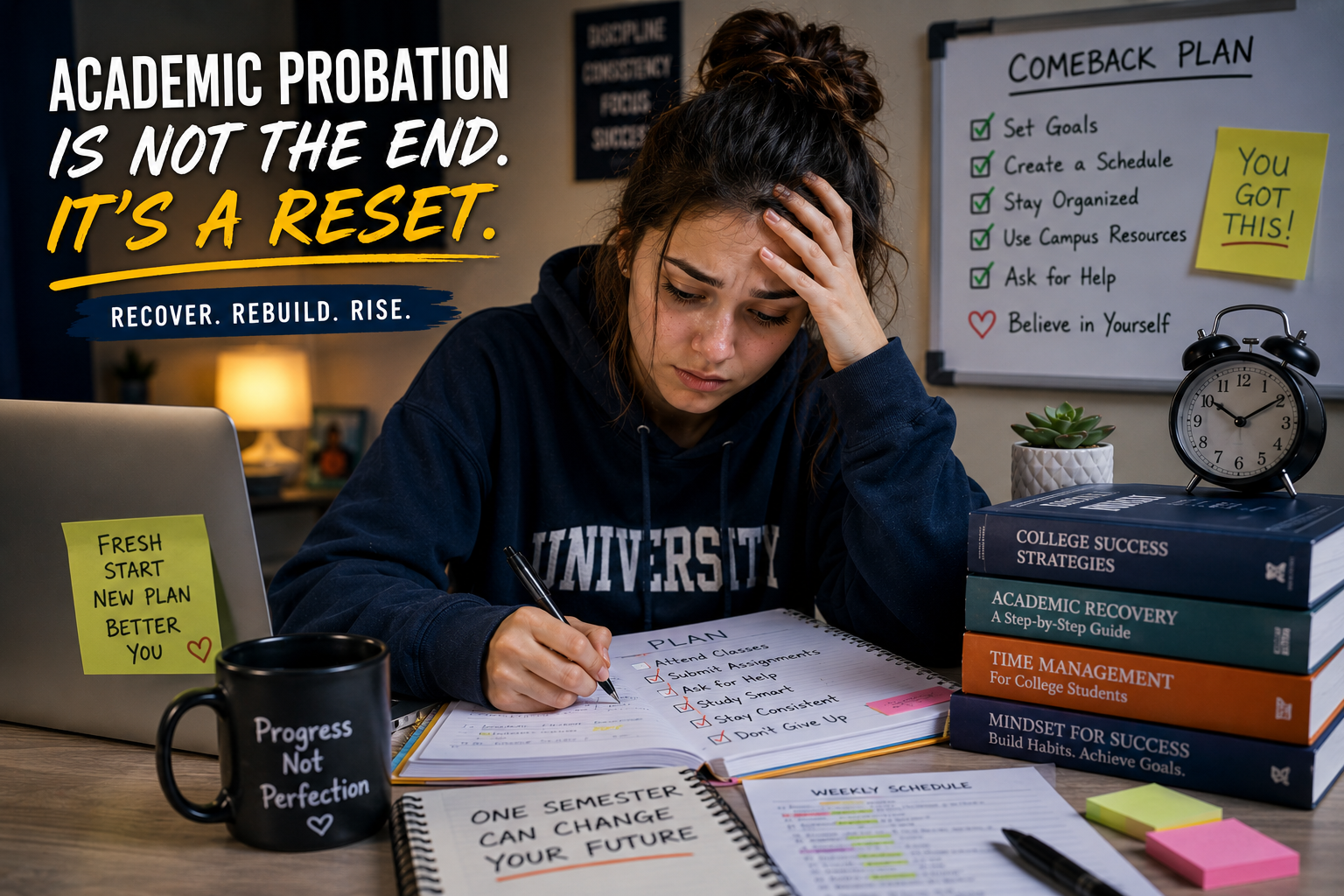
How to Recover From Academic Probation and Rebuild Your GPA
Academic probation can feel like the moment everything starts falling apart. The stress, the embarrassment, the fear of losing scholarships, financial aid, eligibility, or even your place in school can become mentally overwhelming fast.
But here is the truth most students never hear:
Academic probation is not the end of your college story. For many students, it becomes the turning point that forces real change.
Every semester, thousands of college students across the United States fall below GPA requirements due to burnout, poor time management, mental exhaustion, family pressure, financial stress, work schedules, health challenges, or simply struggling to adapt to college life.
Some students quietly spiral after probation because they feel ashamed.
Others recover completely and rebuild stronger academic systems than they had before.
The difference usually comes down to one thing:
Taking action early instead of freezing in panic.
10 MIN READ | 8 SECTIONS | 5 FAQS
What This Guide Covers | Why It Matters | Who Needs This |
|---|---|---|
How academic probation works | Reduces confusion and panic | College students |
How to rebuild your GPA | Creates a realistic recovery plan | Students below GPA requirements |
How to mentally recover after failure | Improves motivation and consistency | Burned out students |
What Academic Probation Actually Means
Academic probation is a warning status assigned when a student’s GPA falls below the minimum requirement set by their college or university.
Most colleges require students to maintain a cumulative GPA between 2.0 and 2.5, depending on the institution and program.
Being placed on probation does not necessarily mean expulsion. Instead, it means the school is giving the student a limited opportunity to improve academically before stronger consequences happen.
Those consequences may include:
Loss of scholarships
Loss of athletic eligibility
Financial aid restrictions
Limited course enrollment
Academic suspension
Dismissal from the institution
According to the National Center for Education Statistics, academic performance challenges are one of the leading reasons students fail to complete degree programs on time.
That sounds scary, but probation itself is more common than many students realize.
And importantly:
Probation is recoverable.
The Emotional Side of Academic Probation Nobody Talks About
One of the hardest parts of academic probation is the psychological impact.
Students often experience:
Shame
Anxiety
Loss of confidence
Fear of disappointing family
Isolation
Burnout
Depression symptoms
Constant panic about grades
Many students stop attending class consistently after probation because they feel embarrassed or mentally defeated.
Others begin avoiding emails, assignments, and academic portals completely because looking at schoolwork triggers stress.
This is extremely dangerous because avoidance makes recovery harder every week.
Academic probation often becomes less about intelligence and more about emotional overwhelm.
The Dangerous “I Already Failed” Mindset
One of the biggest mistakes students make after probation is mentally giving up before the semester even improves.
They start thinking:
“I’m too far behind.”
“There’s no point trying now.”
“Everyone else is doing better than me.”
“I ruined my future.”
But GPA recovery is usually mathematical, not emotional.
Even small improvements in multiple classes can rapidly change your academic standing over one or two semesters.
The key is consistency.
Why Students End Up on Academic Probation
Academic probation rarely happens because of one bad assignment alone.
It usually happens after multiple small issues build up over time.
1. Poor Time Management
Many students underestimate how quickly deadlines accumulate in college.
Missing one discussion board may not seem serious until it turns into:
Missed quizzes
Late essays
Incomplete projects
Attendance penalties
Eventually, grades begin collapsing across several courses at once.
2. Burnout and Mental Exhaustion
Modern students are often overloaded.
Some balance:
Jobs
Sports
Internships
Family obligations
Clinicals
Financial stress
Mental health struggles
When exhaustion builds for months without recovery, academic performance drops naturally.
3. Poor Academic Systems
Many students rely entirely on motivation instead of structure.
That works temporarily.
But eventually motivation disappears, especially during stressful semesters.
Students who survive difficult semesters usually build systems instead of depending on last-minute energy.
4. Avoiding Help Too Long
One of the most common patterns is waiting too long before asking for support.
Some students struggle silently until their GPA becomes critical.
Early intervention matters enormously.
The Core Principle of GPA Recovery
Recovery starts when you stop focusing on perfection and start focusing on stability.
Students on probation often panic and try to “fix everything immediately.”
That usually leads to burnout again.
Instead, strong recovery plans focus on:
Consistent attendance
Smaller daily goals
Assignment completion
Communication with professors
Better scheduling
Reducing overwhelm
You do not need a perfect semester first.
You need a stable semester.
A 5-Step Academic Recovery Plan
Step 1: Understand Your Exact Academic Situation
Before panicking emotionally, look at the actual numbers.
Review:
Your cumulative GPA
Your semester GPA
Course grades
Missing assignments
Scholarship requirements
Probation conditions
Sometimes students assume their situation is worse than it actually is.
Knowing the exact numbers helps create a realistic recovery strategy.
Step 2: Stop Trying to Recover Everything at Once
Students often overwhelm themselves by trying to:
Perfect every assignment
Catch up six classes simultaneously
Study for hours nonstop
Completely change overnight
This rarely works long term.
Instead:
Focus on priority assignments first
Improve one habit at a time
Create smaller deadlines
Reduce mental overload
Step 3: Build a Weekly Recovery System
Successful GPA recovery usually depends on systems more than motivation.
A simple weekly structure might include:
Task | Purpose |
|---|---|
Daily assignment check | Prevents missed deadlines |
Calendar scheduling | Improves time awareness |
2-hour focused study blocks | Increases productivity |
Weekly professor communication | Builds academic accountability |
Sleep and recovery time | Reduces burnout |
Step 4: Communicate With Professors Early
Many students avoid professors after falling behind.
But communication can help significantly.
Professors may:
Offer extensions
Clarify assignments
Provide study guidance
Recommend tutoring resources
Appreciate honesty and effort
Even if extensions are not possible, showing responsibility matters.
Step 5: Protect Your Mental Health During Recovery
Academic recovery becomes extremely difficult when students are mentally exhausted.
Protecting mental health is not “being lazy.”
It is part of sustainable academic performance.
This includes:
Getting sleep
Reducing social comparison
Taking breaks
Managing anxiety
Avoiding all-night panic cycles
Students who recover successfully often learn balance for the first time during probation.
Student-Athletes and Academic Probation
Academic probation can become especially serious for student-athletes because GPA issues may affect NCAA eligibility.
Many athletes struggle balancing:
Training schedules
Travel
Classes
Recovery
NIL obligations
Public pressure
Once grades begin slipping, stress increases rapidly because eligibility becomes tied directly to future opportunities.
This is why academic structure and support systems are critical for student-athletes.
💡 Pro-Tip for 2026: Focus on Assignment Completion Before Grade Perfection
One major reason students fail semesters is incomplete work.
A completed B-level assignment is usually far more valuable than a perfect assignment never submitted.
Recovery students should prioritize:
Submitting work consistently
Avoiding zeros
Completing discussions and quizzes
Maintaining momentum
Consistency compounds over time.
A Realistic Recovery Story
Marcus entered spring semester on academic probation with a 1.8 GPA.
At first, he tried “extreme recovery mode.”
He stayed awake all night studying, overloaded his schedule, and attempted to catch up everything immediately.
Within two weeks, he burned out again.
After meeting with an advisor, Marcus changed strategy completely.
Instead of chasing perfection, he focused on:
Submitting every assignment
Checking Canvas daily
Attending every class
Using weekly scheduling
Reducing distractions
His grades improved slowly.
Then steadily.
By the following academic year, he had rebuilt his GPA above probation level completely.
“Recovery started when I stopped trying to become perfect overnight.”
Frequently Asked Questions (FAQs)
Can you recover from academic probation?
Yes. Many students recover successfully by improving consistency, completing assignments, communicating with professors, and rebuilding time management systems.
How long does it take to rebuild a GPA?
It depends on your current GPA, course load, and grades moving forward. Some students improve significantly within one semester, while others may need a full academic year.
Does academic probation appear permanently on transcripts?
Policies vary by institution. Some colleges note probation temporarily while others maintain records internally. Check your university’s academic policy guidelines.
Can financial aid be affected by academic probation?
Yes. Many schools require students to maintain satisfactory academic progress for financial aid eligibility. Probation may trigger warnings or aid reviews.
What is the fastest way to improve grades after probation?
The fastest improvements usually come from consistent assignment completion, attendance, smaller study systems, and early intervention instead of waiting until deadlines pile up.
Final Thoughts
Academic probation feels overwhelming because it forces students to confront problems they may have ignored for months.
But it can also become the moment students finally build better systems, healthier routines, and stronger academic discipline.
Your GPA is important.
But it is not your identity.
What matters most now is not the semester that went wrong.
It is the recovery plan you build next.
Need academic recovery help? Our team at WritersHubUS helps students manage assignments, coursework, online classes, discussions, and academic pressure before things spiral further. Get started today →
References
National Center for Education Statistics. (2024). College completion and academic performance statistics.
American Psychological Association. (2024). Student stress and academic burnout research.
Purdue Online Writing Lab. (2025). Academic writing and APA style guidance.
U.S. Department of Education. (2025). Satisfactory academic progress policies for financial aid.