ACADEMIC WRITING
Proofreading Your Essays Like a Pro
Master the final, critical stage of writing to eliminate errors, enhance clarity, and submit your work with confidence.
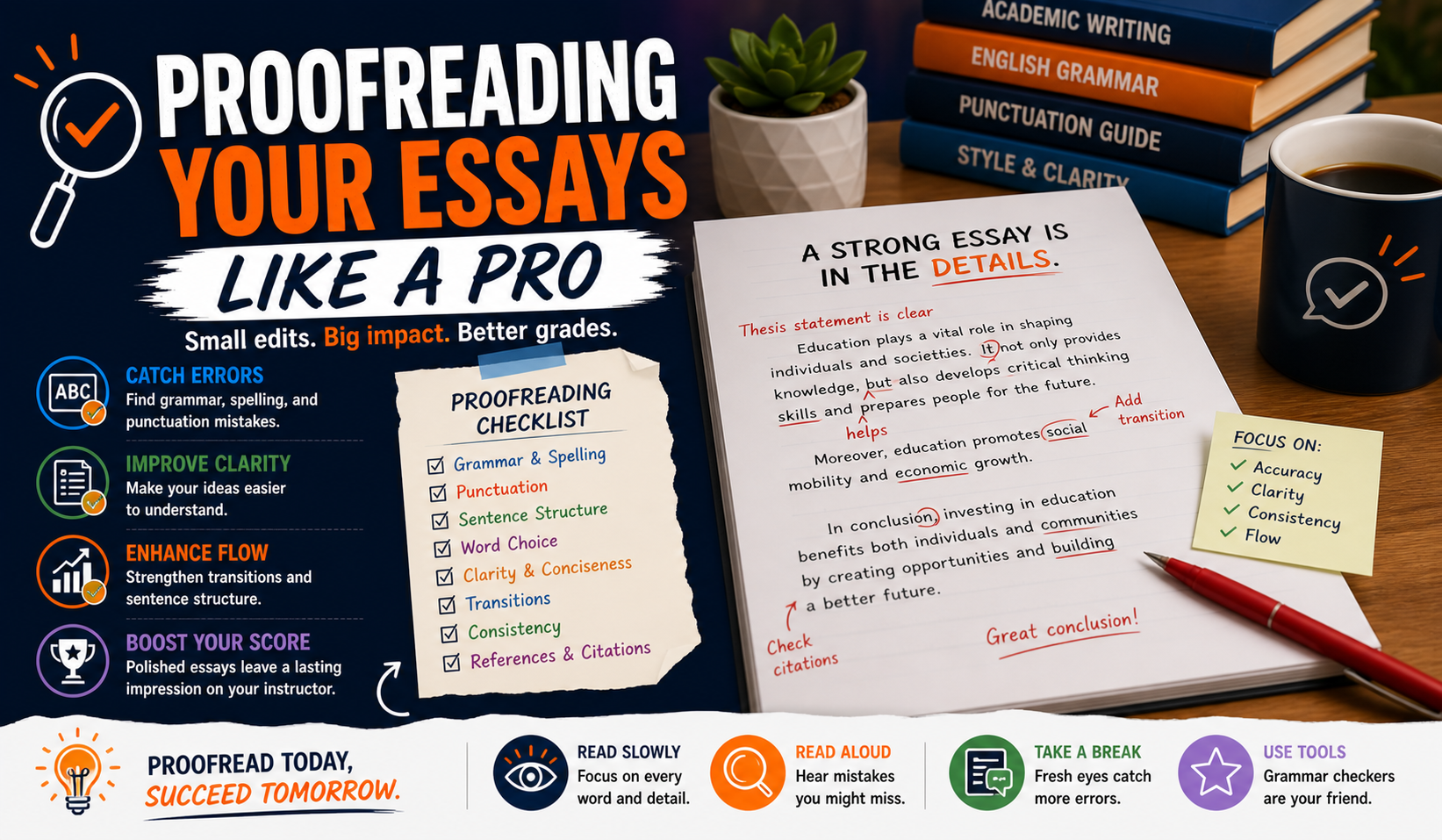
The difference between a good grade and a great one often lies in the smallest details. A meticulously researched essay can lose its impact due to avoidable errors, making professional-level proofreading not just a final check, but a fundamental part of the writing process.
In the demanding world of academia, the quality of your written work is paramount. After spending countless hours researching, structuring, and writing your essay, the final step—proofreading—can feel like a minor chore. However, it is this crucial stage that separates polished, persuasive arguments from those that fall short. It’s a disciplined practice that goes far beyond a simple spell-check, focusing on rooting out every error in grammar, punctuation, syntax, and formatting. Neglecting this step is like building a magnificent house but leaving the windows dirty; the structural integrity is there, but the view is obscured.
This guide provides a comprehensive framework for proofreading your essays like a seasoned professional. We will explore the critical distinction between editing and proofreading, outline a systematic, multi-pass approach to catch different types of errors, and discuss how to leverage technology without becoming overly reliant on it. By implementing these strategies, you will not only improve the quality of your current assignments but also cultivate a lifelong skill that enhances your credibility and communicates your ideas with precision and authority.
20%
Potential Grade Impact
74%
of Readers Notice Grammar
3X
More Effective on Hard Copy
The Foundation: Distinguishing Proofreading from Editing
To proofread effectively, one must first understand what it isn’t: editing. The two terms are often used interchangeably, but they represent distinct stages of the writing cycle. Editing is the process of improving the core content of your essay. It involves assessing the overall structure, the logical flow of your arguments, the clarity of your sentences, and the consistency of your tone. An editor might ask: Is the thesis clear and well-supported? Does this paragraph logically follow the previous one? Is the language engaging and appropriate for the audience? Editing is about shaping the substance of your work.
Proofreading, on the other hand, is the final quality control check. It occurs after all editing revisions are complete and the text is considered final in terms of content. This stage is dedicated exclusively to identifying and correcting surface errors. These include mistakes in spelling, grammar, punctuation, capitalization, number formatting, and citation style. A proofreader isn’t concerned with the strength of an argument but with the correctness of its presentation. Understanding this distinction is vital because it prevents you from trying to do two very different tasks at once, which often leads to missing errors of both types.
The Golden Rule: Always proofread with fresh eyes. Step away from your essay for at least a few hours, or preferably a full day, to create the necessary mental distance to spot mistakes your brain previously overlooked.
Overwhelmed by Deadlines?
Our expert editors can polish your essay for you.
A Systematic, Multi-Pass Approach
The most significant mistake in proofreading is attempting to find every error in a single read-through. The human brain is conditioned to overlook mistakes in favor of understanding the broader meaning. To counteract this, professionals use a multi-pass system, dedicating each review to a specific category of error. This focused approach trains your attention and dramatically increases the number of mistakes you catch. Instead of a single, hurried scan, you conduct several deliberate, targeted checks.
A good multi-pass strategy might include: a first pass just for spelling mistakes and typos, which are often the easiest to spot. A second, slower pass could focus entirely on punctuation—commas, semicolons, apostrophes, and periods. A third pass might check for grammatical consistency, such as subject-verb agreement and correct tense usage. A fourth pass could be dedicated to formatting: ensuring your headings, page numbers, margins, and citations adhere strictly to the required style guide (e.g., APA, MLA, Chicago). This methodical process, while seemingly time-consuming, is far more efficient and effective than a haphazard, all-in-one check.
✓
Enhanced Clarity
Ensure your arguments are communicated precisely without distracting errors.
★
Improved Credibility
A polished, error-free paper signals academic rigor and professionalism.
⏱
Time Efficiency
A structured process is faster and more effective than random checking.
✎
Skill Development
Consciously looking for specific errors makes you a better writer over time.
Leveraging Tools Without Losing Your Voice
In the digital age, we have access to an arsenal of powerful proofreading tools. Software like Grammarly, ProWritingAid, and the built-in checkers in Microsoft Word are invaluable for catching a wide range of errors quickly. They excel at identifying common typos, blatant grammatical miscues, and spelling errors that might slip past a human eye. Using these tools as a first-line defense is a smart and efficient strategy to clean up your document before you begin your own manual review.
However, it is critical to recognize their limitations. Automated tools lack the ability to understand context, nuance, and authorial intent. They may flag complex sentences as "run-ons" when they are stylistically appropriate, or fail to catch homophone errors (e.g., "affect" vs. "effect," "their" vs. "there"). Over-reliance on this software can flatten your writing style and introduce new errors if suggestions are accepted blindly. Think of these tools not as proofreaders, but as helpful assistants. The final judgment on every suggestion must always rest with you, the author, who understands the argument and purpose of the text.
"I used to think a quick spell-check was enough. After following a multi-pass proofreading strategy, I caught so many mistakes in a paper I thought was perfect. It made a noticeable difference in my grade and my professor'''s feedback."
Edwin, Undergraduate Student
Want a Second Pair of Expert Eyes?
Submit your essay and get professional feedback in hours.
Our Professional Proofreading Process
1
Upload Your Document
Securely submit your essay draft and provide any specific instructions.
2
Expert Assignment
We match your paper with a subject-relevant editor for a thorough review.
3
Receive Edits & Feedback
Get back a track-changed document with corrections and constructive advice.
4
Submit with Confidence
Review the changes, approve the final version, and submit your polished essay.
Advanced Techniques for Flawless Prose
Beyond the basics, several advanced techniques can help you catch the most elusive errors. One of the most powerful is to read your essay backward, starting with the last sentence and working your way to the first. This de-contextualizes the writing, forcing your brain to focus on the mechanics of each individual sentence rather than the flow of the argument. Another effective method is to change the appearance of the document: alter the font, increase the text size, or change the background color. This "defamiliarization" tricks your brain into perceiving the text as a new document, making it easier to spot errors you had become blind to. Finally, don’t underestimate the power of print. Reading a hard copy of your essay often reveals mistakes that are easily missed on a screen, as the different medium engages your brain in a new way.
The Read-Aloud Test: Reading your paper aloud is one of the most effective proofreading techniques. It forces you to slow down and helps you identify awkward phrasing, run-on sentences, and missed punctuation that your eyes might skim over.
Ready to Submit Your Best Work?
Let our academic editors provide the final polish your essay deserves. Achieve clarity, correctness, and confidence.