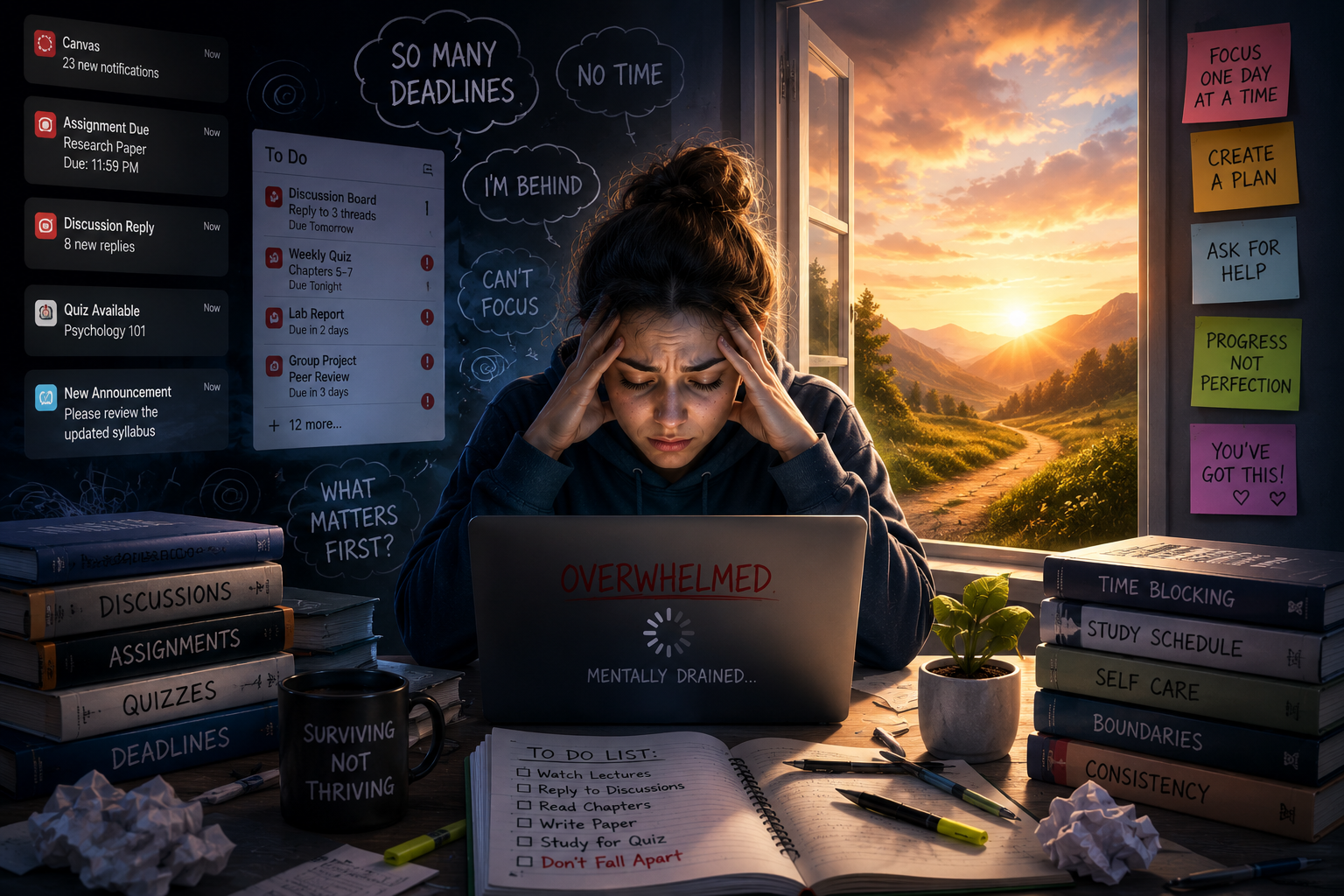
Online Classes Are Mentally Draining — Here’s Why Students Are Struggling
Online classes were supposed to make life easier. Flexible schedules. Learning from home. No commuting. More freedom.
But for many college students, online learning quietly became something else entirely:
Constant notifications. Endless deadlines. Mental exhaustion. Isolation. Burnout.
What looked convenient on the surface slowly became emotionally draining underneath.
Today, many students are not struggling because they are incapable of learning.
They are struggling because online education changed the way academic pressure follows them every hour of the day.
11 MIN READ | 8 SECTIONS | 5 FAQS
What This Guide Covers | Why It Matters | Who Needs This |
|---|---|---|
Why online classes feel exhausting | Helps students understand burnout | College students |
Common online learning struggles | Improves awareness and recovery | Remote learners |
How students can regain structure | Builds consistency and productivity | Students falling behind |
The Hidden Problem With Online Classes
One of the biggest misconceptions about online learning is that students are “doing less work” because they are not physically in classrooms.
In reality, many students feel like they are constantly connected to school without ever mentally leaving it.
Traditional classes usually create separation:
Classroom time
Study time
Home time
Rest time
Online learning blurred those boundaries completely.
Now students wake up, check assignments on their phones, answer discussion boards while eating, watch lectures late at night, and feel guilty whenever they are not being productive.
School no longer feels like a place.
It feels like an endless notification system.
Why Students Feel Mentally Exhausted in Online Classes
1. The Work Never Feels “Finished”
In online learning environments, assignments constantly update.
Students log into platforms like Canvas, Blackboard, Moodle, or Google Classroom and immediately see:
New announcements
Discussion replies
Quizzes
Weekly modules
Unread notifications
Submission reminders
Even after completing one assignment, three more often appear immediately.
This creates a psychological feeling of never catching up.
Students are not only studying anymore. They are constantly managing digital academic pressure.
2. Isolation Makes Motivation Harder
Online classes can become extremely isolating.
Many students spend entire days learning alone without:
Face-to-face conversations
Classroom energy
Study groups
Social interaction
Immediate support from professors
Over time, motivation drops because humans naturally respond to social environments.
Without physical structure, many students struggle maintaining momentum.
According to research published through the National Center for Education Statistics, students in remote learning environments often report lower engagement and higher stress levels compared to traditional classroom settings.
3. Burnout Happens Faster Online
Many students assume burnout only comes from hard work.
But digital overload can be exhausting too.
Students often spend:
6–10 hours on screens daily
Watching recorded lectures
Typing discussion responses
Researching assignments
Checking grades constantly
Refreshing academic portals
Eventually the brain stops feeling focused.
Everything begins feeling repetitive and mentally heavy.
The Psychology Behind Online Learning Fatigue
Online classes create a unique type of mental fatigue because they require students to self-manage almost everything independently.
Students must become:
Their own scheduler
Their own accountability system
Their own reminder system
Their own study coach
Their own time manager
That level of constant self-regulation drains mental energy quickly.
In physical classrooms, structure already exists naturally.
Online learning forces students to create structure themselves every day.
Why So Many Students Start Falling Behind
Most students do not suddenly collapse academically overnight.
Falling behind usually begins with small delays that slowly compound.
The Typical Online Class Spiral
What Happens First | What Happens Next |
|---|---|
One missed assignment | Stress increases |
Student avoids checking the portal | Deadlines accumulate |
More notifications appear | Overwhelm grows |
Student procrastinates further | Grades begin dropping |
Panic starts | Burnout intensifies |
Many students eventually stop opening their online portals entirely because the stress becomes emotionally overwhelming.
This avoidance cycle is extremely common.
The Core Principle of Surviving Online Classes
Students survive online learning when they create structure before stress takes over.
Motivation alone is unreliable.
Most students wait until panic forces productivity.
That works temporarily but destroys mental energy long term.
Students who perform better online usually rely on systems instead of emotional motivation.
A 5-Step System for Managing Online Class Burnout
Step 1: Stop Checking Everything at Once
One major reason students panic is because they look at all assignments simultaneously.
Instead:
Identify priority deadlines first
Break assignments into smaller tasks
Focus on one course at a time
Overwhelm shrinks when tasks become specific.
Step 2: Create Fixed Study Hours
Online students often study randomly throughout the day.
This destroys consistency.
Instead, create predictable study blocks like:
9 AM – 11 AM
2 PM – 4 PM
7 PM – 9 PM
The brain performs better when routines become predictable.
Step 3: Reduce Constant Notification Stress
Students frequently keep academic notifications active 24/7.
This creates constant mental pressure.
Instead:
Schedule specific times to check assignments
Disable unnecessary alerts
Avoid checking grades repeatedly
Not every notification deserves immediate emotional attention.
Step 4: Prioritize Completion Over Perfection
Many students fall behind because they overthink every assignment.
A completed assignment usually helps more than a perfect assignment submitted late or never submitted at all.
Momentum matters.
Step 5: Protect Your Mental Health
Students often treat exhaustion like weakness.
But burnout directly affects:
Memory
Focus
Motivation
Academic performance
Decision-making
Recovery matters.
Students need:
Sleep
Breaks
Movement
Social interaction
Mental reset time
Student-Athletes Face Even More Pressure Online
Online learning becomes even harder for student-athletes balancing:
Training schedules
Travel
Recovery
NIL opportunities
Practices
Academic deadlines
Many athletes finish workouts physically exhausted and still face multiple online assignments waiting late at night.
This combination of physical fatigue and academic pressure creates serious burnout risks.
💡 Pro-Tip for 2026: Build “Low-Energy Productivity” Systems
Most students only plan for productive days.
That is a mistake.
The strongest academic systems work even when motivation is low.
Examples include:
Studying in small sessions
Daily assignment checklists
Pre-planned study blocks
Templates for discussion responses
Using calendars consistently
The goal is not becoming perfect.
The goal is staying functional during stressful weeks.
A Realistic Online Class Story
Sophia originally loved online classes because they seemed flexible.
At first, everything felt manageable.
But after several weeks, assignments started overlapping across multiple courses.
Discussion boards piled up.
Quizzes appeared unexpectedly.
Announcements never stopped.
Eventually she stopped checking Canvas regularly because opening it triggered anxiety immediately.
That avoidance made everything worse.
Finally, Sophia changed strategy completely.
Instead of trying to “feel motivated,” she created a simple structure:
Morning assignment review
Two focused study blocks daily
One course at a time
No late-night panic studying
Her grades improved slowly.
But more importantly:
Her stress became manageable again.
Frequently Asked Questions (FAQs)
Why do online classes feel more exhausting than in-person classes?
Online learning often creates constant digital pressure, isolation, screen fatigue, and self-management demands that mentally drain students over time.
How can I stop falling behind in online classes?
Breaking assignments into smaller tasks, using fixed study schedules, reducing avoidance, and checking academic portals consistently can help prevent overwhelm.
Are online classes harder for mental health?
For many students, yes. Isolation, constant notifications, lack of structure, and digital overload can increase anxiety, stress, and burnout.
Why do students procrastinate more online?
Online environments provide less physical accountability and structure, making distractions and avoidance easier. Stress and overwhelm also increase procrastination behaviors.
Can online learning still work for students?
Yes. Students who create consistent systems, routines, and healthy schedules often perform much better in online environments over time.
Final Thoughts
Online classes are not mentally draining because students are weak.
They are draining because modern online learning often removes structure while increasing constant academic pressure.
Students are expected to stay productive, focused, organized, and motivated every day inside environments filled with distractions and digital overload.
That is exhausting.
The solution is not becoming perfect.
The solution is building systems strong enough to survive difficult weeks without collapsing completely.
Need online class help before things spiral further? Our team at WritersHubUS helps students manage discussions, assignments, quizzes, coursework, and online classes while reducing academic stress. Get started today →
References
National Center for Education Statistics. (2024). Online learning engagement and student performance statistics.
American Psychological Association. (2024). Student burnout and digital learning stress research.
Purdue Online Writing Lab. (2025). Academic productivity and online learning resources.
U.S. Department of Education. (2025). Remote learning and higher education trends.