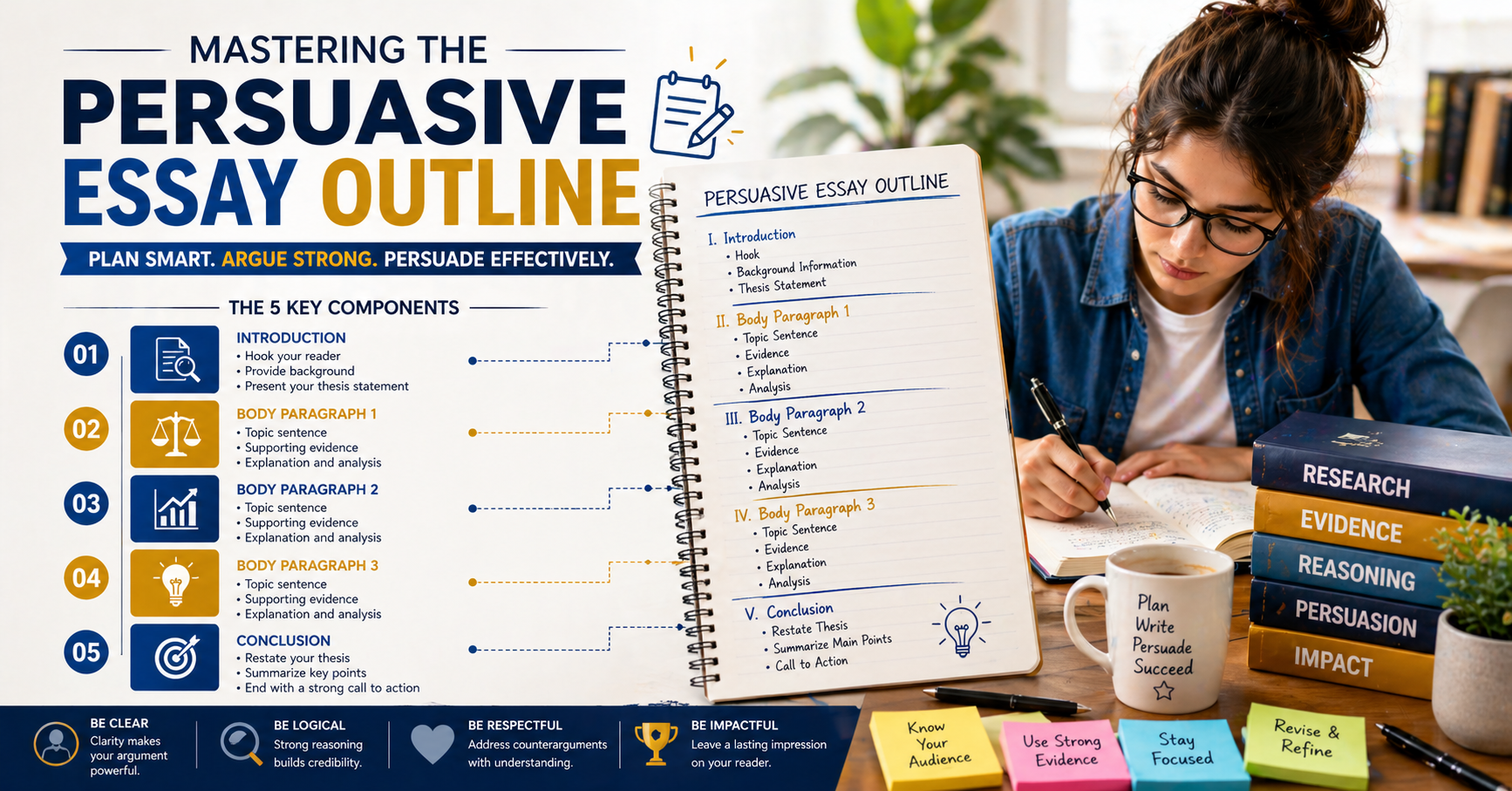
A powerful persuasive essay doesn’t begin with a brilliant first sentence; it begins with a brilliant blueprint. This guide provides that blueprint, turning your complex ideas into a clear, compelling, and convincing argument.
For many students, the blank page is the most intimidating part of writing a persuasive essay. The pressure to articulate a strong argument, support it with evidence, and maintain a logical flow can be overwhelming. The secret isn’t to just start writing and hope for the best; it’s to start planning. A well-crafted outline is the strategic roadmap for your argument, guiding you from your opening statement to your final, powerful conclusion.
Think of it as the architectural plans for a building. Without them, you risk a weak foundation, crooked walls, and a structure that might collapse under scrutiny. With a solid outline, you ensure every paragraph has a purpose, every piece of evidence is well-placed, and your final essay is sturdy, coherent, and, most importantly, persuasive. It transforms writing from an act of anxiety into an act of construction.
Why Your Persuasive Essay Needs a Blueprint
The primary function of a persuasive essay outline is to create logical coherence. It forces you to think through your argument before you commit to full paragraphs. This process ensures that your points connect in a rational sequence, with each idea building upon the last. Without an outline, your essay can easily become a collection of disjointed thoughts, making it difficult for the reader to follow your train of thought and diminishing the persuasive power of your message.
Furthermore, an outline provides a framework for organizing your evidence. As you map out your main points, you can strategically place your strongest supporting details—statistics, quotes, examples, and expert opinions—where they will have the most impact. This prevents you from "front-loading" all your good evidence or, worse, forgetting to include crucial facts. It allows you to see your argument at a glance, identify potential gaps in your reasoning, and ensure that every claim is adequately supported.
The Core Principle: An outline is more than a checklist; it's a structural integrity test for your argument before you lay the first brick.
The Anatomy of a Killer Persuasive Outline
While formats can vary, a strong persuasive essay outline universally contains three core sections. First is the Introduction, which must contain a compelling hook to grab the reader's attention, provide brief context on the topic, and, most critically, present a clear, debatable thesis statement. This thesis is the anchor for your entire essay, so it needs to be concise and assertive.
Next are the Body Paragraphs, with each paragraph dedicated to a single main point that supports your thesis. Every body paragraph in your outline should start with a topic sentence that introduces this point. Underneath the topic sentence, you should list the specific evidence (facts, data, quotes) you will use and a brief note on your analysis—explaining how that evidence proves your point. Finally, the Conclusion should restate the thesis in a new way, briefly summarize your main points, and leave the reader with a powerful final thought or call to action.
The Thesis Statement: Your North Star
The single most important component of your outline is the thesis statement. It is the central claim that you will spend the entire essay proving. A weak, vague, or purely factual thesis will lead to a weak, meandering essay. Your thesis must be arguable—meaning someone could reasonably disagree with it—and specific enough to be thoroughly defended within the confines of the essay.
In your outline, place your thesis statement prominently at the end of the introduction section. Every topic sentence you write for your body paragraphs must directly link back to and support this thesis. If you find a topic sentence doesn’t align, you either need to revise the topic sentence or, in some cases, refine your thesis statement itself. The outline is the perfect place to make these adjustments before you invest time in writing prose.
"I used to just start writing and hope for the best. Learning to outline properly was a game-changer. My arguments became tighter, my writing process was halved, and my grades shot up. I can't imagine writing an essay without one now."
Crafting Your Outline in 4 Simple Steps
Beyond the Basics: Incorporating Counterarguments
A truly masterful persuasive essay does not ignore opposing viewpoints; it confronts them directly. Including a counterargument section in your outline demonstrates to your reader that you have considered the topic from multiple angles. It shows intellectual maturity and strengthens your own position by proving it can withstand challenges. In your outline, dedicate a body paragraph to fairly presenting a common counterargument. Then, in the same paragraph, systematically refute it using logic and evidence. This act of acknowledging and dismantling the opposition can be one of the most persuasive techniques in your arsenal.
Pro Tip: Addressing a counterargument doesn't weaken your essay—it demonstrates confidence and thorough research, making your own position more convincing.
Build a Winning Essay from the Ground Up
Don't leave your grade to chance. Get professional help and submit an essay that truly stands out.