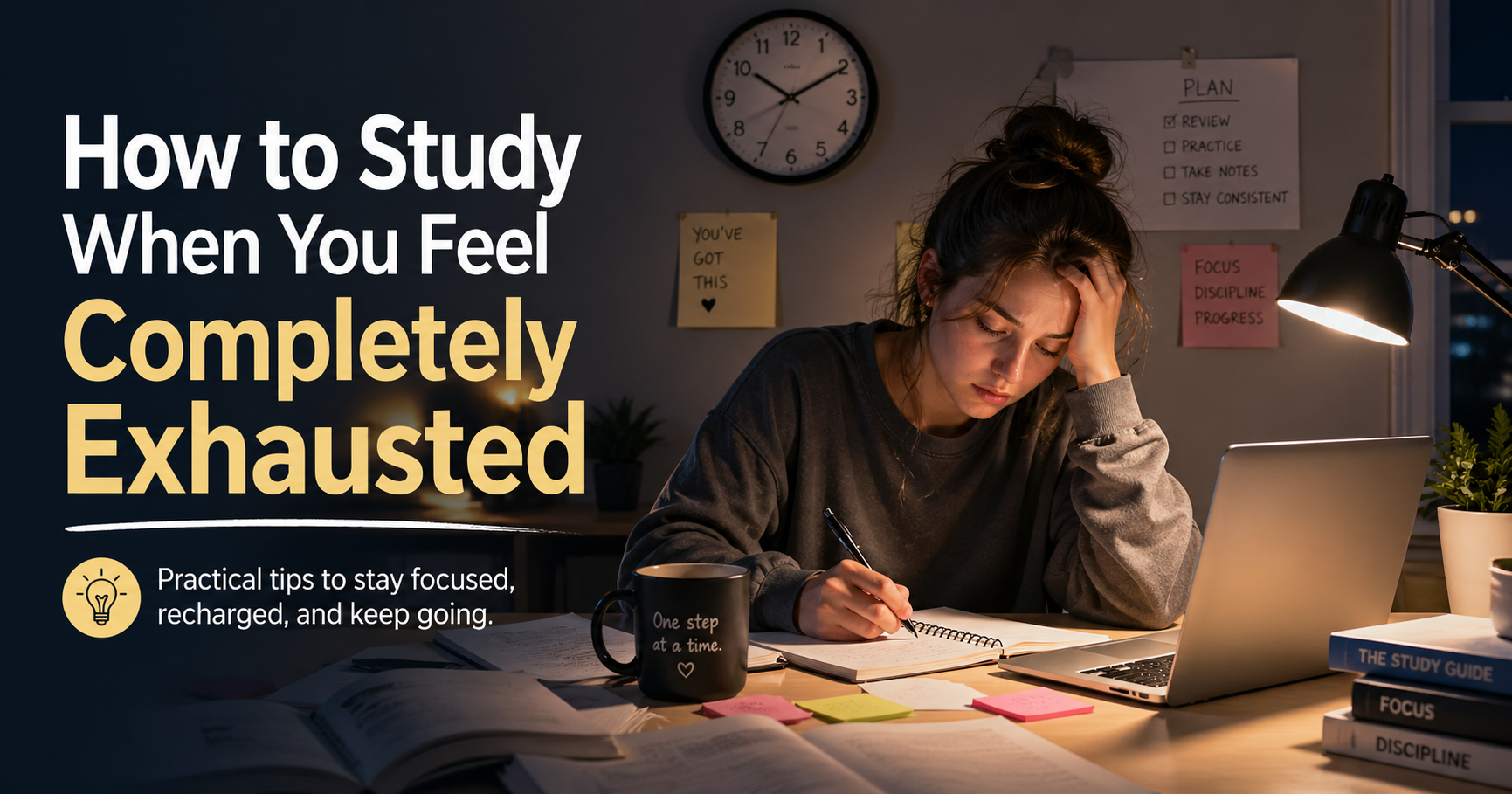
How to Study When You Feel Completely Exhausted
There are days when studying feels almost impossible.
You open your laptop. You stare at the assignment. You read the same sentence again and again, but nothing stays in your mind. Your body is tired, your brain feels heavy, and even a small task feels bigger than it should.
That does not always mean you are lazy.
Sometimes, it means you are exhausted.
College students deal with pressure from classes, assignments, exams, online discussions, jobs, family responsibilities, and personal stress. When all of that builds up, your brain can reach a point where it simply refuses to focus.
So the real question is not, “How do I force myself to study harder?”
The better question is, “How do I study in a smarter way when my energy is already low?”
This guide breaks it down.
Why Studying Feels So Hard When You Are Exhausted
When you are exhausted, your brain does not work at full strength.
You may notice that:
You lose focus quickly.
You forget what you just read.
You keep delaying the assignment.
You feel irritated by small tasks.
You feel guilty for not doing enough.
You want to sleep but also feel stressed about deadlines.
That is not just a motivation problem. It can be a sign of cognitive overload, poor rest, academic pressure, or burnout.
This is why tired students need more than motivation quotes. They need a realistic system that works even when energy is low.
1. Lower the Pressure First
When students feel exhausted, they often make the mistake of expecting full energy performance.
They tell themselves:
“I need to finish everything tonight.”
“I have to study for five hours.”
“I cannot rest until I complete this.”
That kind of pressure can make the brain shut down even more.
Instead, lower the pressure and focus on one useful action.
Ask yourself:
“What is the smallest academic task I can complete right now?”
That could be:
Reading one page
Writing one paragraph
Opening the assignment instructions
Creating a simple outline
Reviewing five key terms
Checking the due date
Completing one discussion response
This matters because exhausted students need momentum before intensity.
Do not start by trying to win the whole semester in one night. Start by creating movement.
2. Choose the Task That Protects Your Grade the Most
When your energy is low, you cannot treat every assignment equally.
You need to be strategic.
Before studying, check:
What is due first?
What is worth the most points?
What will damage your grade the most if ignored?
What can be completed quickly?
What task is blocking everything else?
Start with the assignment that protects your grade the most.
For example, if you have a short quiz, a weekly discussion, and a major paper due soon, the major paper may deserve priority. If the discussion closes tonight, then the discussion may come first.
The goal is not to do everything at once.
The goal is to protect your grade with the limited energy you have.
Exhausted students do not need a perfect plan. They need a priority plan.
3. Use the 10 Minute Start Method
When you feel completely drained, starting is usually the hardest part.
The 10 minute method works because it removes the pressure of finishing.
Set a timer for 10 minutes and choose one small task.
For 10 minutes, you can:
Read the assignment prompt
Write rough notes
Find one source
Review one lecture slide
Solve one problem
Create a heading
Write a rough introduction
After 10 minutes, you can stop or continue.
The goal is not to trick yourself into working for hours. The goal is to break the mental resistance that keeps you stuck.
Many students waste more energy avoiding the task than the task itself would actually require.
4. Study in Short Blocks, Not Long Marathons
When you are exhausted, long study marathons usually fail.
Your attention drops. Your memory weakens. You become slower. Then you start feeling worse because you spent hours “studying” but barely completed anything.
Short study blocks are better.
Try this structure:
20 minutes of focused work
5 minutes of rest
20 minutes of focused work
10 minutes of rest
Repeat only if your brain can handle it.
This is important because tired students often believe they need more hours. In reality, they often need better structure.
A focused 20 minute session can be more useful than two distracted hours.
5. Make the Assignment Easier Before You Try to Finish It
Do not begin with the hardest version of the task.
If you are exhausted, your first job is to reduce friction.
If you have an essay, do not start by trying to write the perfect introduction.
Start with:
The topic
The main argument
Three body points
Two possible sources
A rough conclusion idea
If you have an exam, do not start by rereading the whole chapter.
Start with:
Key terms
Study guide questions
Lecture headings
Practice questions
Old quizzes
If you have an online class, do not open everything at once.
Start with:
Announcements
Due dates
Missing work
Current grade
The next assignment
When your brain is tired, clarity is power.
The more organized the task looks, the less overwhelming it feels.
6. Stop Passive Studying
When you are tired, passive studying is dangerous because it feels productive even when it is not.
Passive studying includes:
Rereading notes without testing yourself
Highlighting too much
Watching lectures without taking notes
Staring at slides
Copying definitions without understanding them
Instead, use active study methods.
Try:
Writing a short summary from memory
Explaining the concept out loud
Answering practice questions
Creating flashcards
Teaching the idea to an imaginary student
Writing what you know before checking notes
Turning headings into questions
Active studying forces your brain to engage. It also shows you what you understand and what still needs attention.
If you are exhausted, do not study longer.
Study sharper.
7. Take Sleep Seriously
Many students sacrifice sleep when deadlines are close.
Sometimes that feels necessary, but repeated sleep loss can hurt focus, memory, mood, and academic performance.
That does not mean you should ignore urgent work and sleep all day. It means you should stop treating sleep like wasted time.
If you are too tired to think clearly, a short nap or proper sleep may be more useful than forcing three unfocused hours at your desk.
Good sleep helps your brain process information, remember material, and stay emotionally stable under pressure.
8. Use a Real Break, Not a Fake Break
A fake break is when you stop studying but keep draining your brain.
Examples include:
Scrolling for one hour
Arguing in messages
Watching stressful content
Opening ten apps
Checking grades repeatedly
Comparing yourself to other students
A real break helps your brain recover.
Try:
Drinking water
Eating something light
Taking a short walk
Stretching
Showering
Breathing quietly for five minutes
Sitting outside
Closing your eyes without your phone
The goal is to return with more energy than you had before the break.
If your break makes you more tired, more distracted, or more anxious, it is not helping.
9. Create a Low Energy Study Plan
Some days, you will not have enough energy for deep studying.
That is when you need a low energy plan.
Use this simple format.
If You Have 10 Minutes
Check your due dates.
Open the assignment.
Write three bullet points.
Read one page.
Review five terms.
If You Have 30 Minutes
Complete one small task.
Outline one section.
Review one topic.
Write one paragraph.
Answer one discussion post.
If You Have 60 Minutes
Finish one assignment section.
Study one chapter summary.
Complete a quiz review.
Draft a full outline.
Revise one part of a paper.
This kind of plan helps because it removes the excuse of, “I do not have enough energy to do everything.”
You may not be able to do everything, but you can usually do something.
10. Know the Difference Between Tired and Burned Out
Being tired for one night is normal.
Burnout is different.
Burnout can feel like:
Constant exhaustion
Loss of motivation for weeks
Feeling emotionally drained
Avoiding schoolwork completely
Feeling detached from classes
Struggling to care about grades
Feeling overwhelmed by basic tasks
If you feel burned out for a long time, do not ignore it.
Talk to someone who can help, such as a professor, advisor, counselor, tutor, classmate, or trusted support system.
Waiting until everything collapses usually makes recovery harder.
11. Ask for Help Before You Fall Too Far Behind
Many students wait too long before asking for help.
They think asking for help means they are weak, lazy, or not smart enough.
That is not true.
Academic support is part of academic survival.
You may need help if:
You keep missing deadlines
You do not understand the instructions
You are failing multiple assignments
You are behind in an online class
You cannot manage the workload
You are working long hours and falling behind
You are too exhausted to complete everything alone
Smart students do not wait until the last minute to build support. They protect their grades before the situation gets worse.
Final Student Checklist
Before you study while exhausted, ask yourself:
What is the most important task right now?
What is due first?
What can I finish in 10 minutes?
Can I break this assignment into smaller parts?
Am I studying actively or just staring at notes?
Do I need a real break?
Have I slept enough to think clearly?
Do I need help before this gets worse?
This checklist can help you move from panic to action.
Final Thoughts
Studying when you feel completely exhausted is not about forcing yourself to act like you have unlimited energy.
It is about using the energy you have wisely.
Start small. Choose the task that matters most. Study in short blocks. Take real breaks. Protect your sleep. Use active study methods. Ask for help when the workload becomes too much.
You do not need to fix everything in one night.
You just need to take the next smart step.
And sometimes, that one step is enough to help you feel back in control.