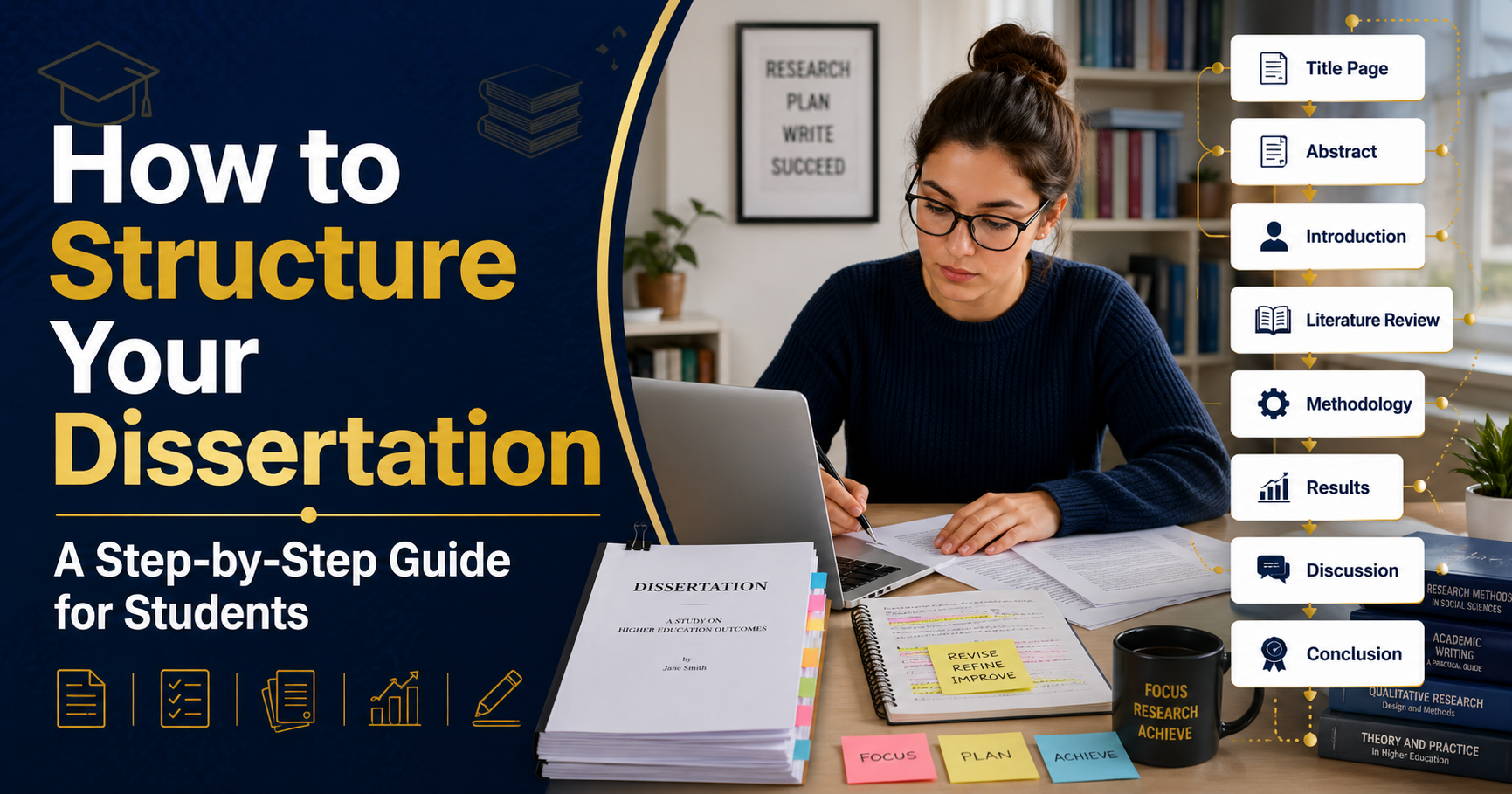
How to Structure Your Dissertation: A Step-by-Step Guide for Students
Introduction
Writing a dissertation can feel overwhelming. Many students struggle not because they lack knowledge, but because they do not know how to structure their work properly.
A well-structured dissertation makes your research clear, logical, and easy to follow. It also increases your chances of getting higher grades.
This guide breaks down the exact structure you need to follow.
What Is a Dissertation Structure?
A dissertation structure is the organized layout of your research project. It ensures that your ideas flow logically from one section to another.
Most universities follow a standard format, which includes:
Introduction
Literature Review
Methodology
Results
Discussion
Conclusion
Understanding each section is key.
1. Title Page
This is the first page of your dissertation.
It includes:
Your title
Your name
Institution
Course
Submission date
Keep it clean and professional.
2. Abstract
The abstract is a short summary of your entire dissertation.
Include:
Research topic
Objectives
Methods
Key findings
Conclusion
Keep it between 150 to 300 words.
3. Introduction
This section sets the foundation of your work.
You should:
Introduce your topic
Explain why it matters
State your research question
Present your thesis
Your introduction should clearly tell the reader what to expect.
4. Literature Review
This section reviews existing research related to your topic.
You need to:
Analyze previous studies
Identify gaps in research
Show how your work fits in
Do not just summarize. Show critical thinking.
5. Methodology
Here, you explain how you conducted your research.
Include:
Research design
Data collection methods
Tools used
Limitations
This section must be clear and detailed.
6. Results
Present your findings without interpretation.
Use:
Tables
Charts
Data summaries
Keep it factual and organized.
7. Discussion
This is where you explain your results.
You should:
Interpret your findings
Compare with existing research
Explain what your results mean
This section shows your analytical skills.
8. Conclusion
Summarize your key points.
Include:
Main findings
Answer to your research question
Recommendations
Keep it concise and strong.
9. References
List all sources used in your dissertation.
Follow the required format such as:
APA
MLA
Harvard
Accuracy here is critical.
Key Tips for a Strong Dissertation
Stay consistent with formatting
Follow your university guidelines
Use clear headings and subheadings
Keep your writing simple and direct
Proofread your work carefully
Common Mistakes to Avoid
Poor organization
Weak research question
Lack of evidence
Ignoring formatting rules
Rushing the final draft
Avoiding these mistakes improves your final result.
Final Thoughts
A dissertation is not just about research. It is about presenting your work in a clear and structured way.
When your structure is strong, everything else becomes easier.
Focus on organization, clarity, and consistency.
That is how you complete a dissertation successfully.