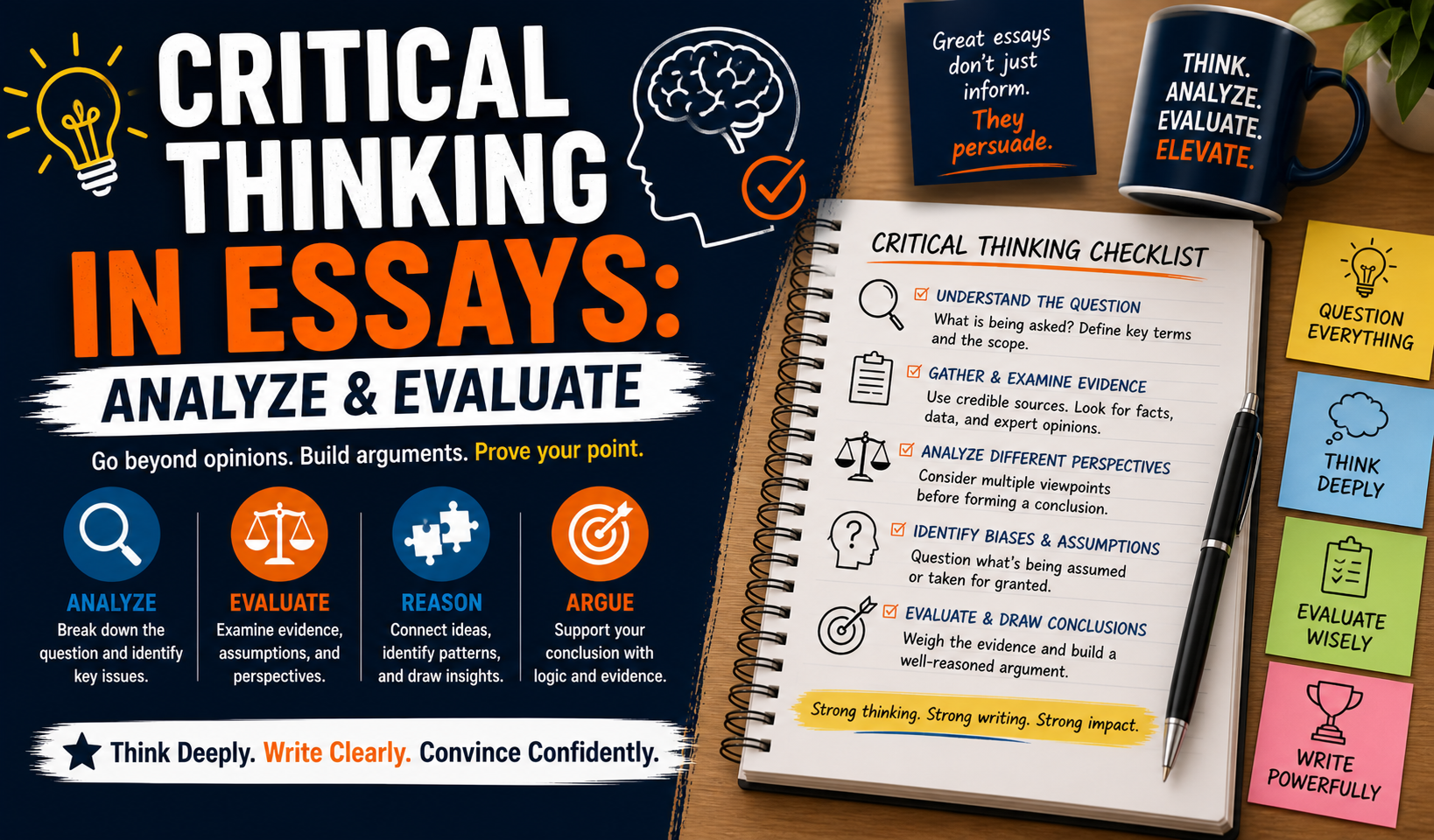
Essay Skills
Mastering the Essay: A Guide to Critical Analysis
Move beyond description and learn to deconstruct arguments, evaluate evidence, and construct compelling essays that showcase your intellectual depth.
The difference between a good essay and a great one often lies in a single, powerful skill: critical thinking. It is the engine that drives insightful analysis and elevates your work from a simple summary to a sophisticated academic argument.
In academic writing, critical thinking is the process of actively and skillfully conceptualizing, applying, analyzing, synthesizing, and evaluating information. It’s about not taking information at face value. Instead of simply reporting what you’ve read, you are expected to engage with it, question it, and use it to build your own reasoned arguments. This skill is paramount, as it demonstrates a deeper understanding of the subject matter and your ability to contribute to the academic conversation.
This guide will walk you through the essential components of critical thinking for essay writing. We’ll explore how to dissect sources, identify underlying assumptions, evaluate the credibility of evidence, and ultimately synthesize disparate information into a coherent and persuasive thesis. By mastering these techniques, you can transform your approach to essay writing, producing work that is not only well-researched but also intellectually rigorous and impactful.
87%
of educators believe students lack critical analysis skills
41%
higher grades for students with strong analytical skills
93%
of employers value critical thinking over a specific major
What is Critical Thinking in Academic Writing?
At its core, critical thinking in the context of essay writing is about becoming a discerning consumer and producer of knowledge. It involves a methodical process of breaking down information (analysis) and reassembling it to create new meaning (synthesis). Your goal is to move past the surface of a text to understand its deeper structure, its explicit arguments, and its implicit assumptions. This requires you to play the role of a skeptic, questioning the author's claims, examining the quality of their evidence, and considering alternative interpretations.
Furthermore, it demands self-awareness. Critical thinking involves reflecting on your own biases and preconceptions. Are you approaching a source with a predetermined conclusion? Are you giving more weight to evidence that confirms your existing beliefs? A critical thinker strives for objectivity, allowing the evidence to shape their argument, rather than fitting evidence into a preconceived narrative. This analytical rigor is what professors look for as a sign of intellectual maturity.
The Core Shift: Critical thinking transforms you from a passive recipient of information into an active participant in an academic dialogue, where you challenge, analyze, and contribute.
Struggling with a Complex Essay?
Our expert writers can help you analyze sources and build a powerful argument.
The First Step: How to Actively Read and Analyze Sources
Critical thinking begins long before you write the first word of your essay; it starts with how you read. Passive reading, where you simply absorb words on a page, is insufficient for academic work. You must engage in active reading, which is a process of dialogue with the text. Before you read, consider the context: Who is the author? When and where was this published? What might be the author’s purpose or potential biases?
As you read, transform into an interrogator. Highlight the author's main argument or thesis. Identify the key pieces of evidence used to support it. Ask yourself: Is the evidence relevant, sufficient, and credible? Does the author acknowledge counterarguments? Note any assumptions the author makes—premises that are taken for granted but not explicitly proven. This annotation process is not just about highlighting; it's about creating a roadmap of the author's thinking, which you can then critique in your essay.
✓
Deeper Understanding
Move beyond surface-level facts to grasp the core logic of an argument.
★
Stronger Arguments
Build your essays on a solid foundation of well-evaluated evidence.
✎
Original Insights
Develop your own unique perspective and contribute a distinct academic voice.
🎓
Improved Grades
Earn higher marks by demonstrating superior analytical skills to your professors.
Evaluating Information: Spotting Bias, Assumptions, and Fallacies
Once you have analyzed a source, the next step is evaluation. This is where you assess the strength and validity of the author's argument. A primary task is to identify bias. Bias can stem from a particular ideological viewpoint, commercial interest, or personal agenda. Look for loaded language, selective use of evidence, or a consistent pattern of framing one perspective favorably. Acknowledging an author's bias doesn't necessarily invalidate their work, but it is crucial context for your analysis.
Simultaneously, you must hunt for logical fallacies—flaws in reasoning that weaken an argument. Common fallacies include ad hominem attacks (attacking the person instead of the argument), straw man arguments (misrepresenting an opponent's position), and false dichotomies (presenting only two options when more exist). Identifying these fallacies allows you to attack the weak points in a source's argument and demonstrate your own logical acuity. This evaluative process ensures you use only the most robust evidence to support your own thesis.
"For my history thesis, I used to just collect facts that supported my idea. Learning to truly analyze sources—even those I disagreed with—forced me to build a much more nuanced and defensible argument. It completely changed how I approach research and writing."
— kelvin, Graduate Student
Need an Expert's Eye on Your Draft?
Get a detailed review focusing on argumentation, analysis, and structure.
How It Works: A 4-Step Process for Critical Essay Writing
1
Deconstruct the Prompt
Carefully analyze the essay question to understand its core requirements and underlying assumptions.
2
Gather & Analyze Sources
Actively read and critique a wide range of relevant academic literature, noting arguments and evidence.
3
Synthesize and Outline
Formulate your unique thesis and structure your argument logically based on your critical evaluation of sources.
4
Draft and Refine
Write your essay with a focus on clear analysis, then revise meticulously for clarity, coherence, and impact.
From Analysis to Synthesis: Building Your Own Argument
The final and most crucial stage of critical thinking is synthesis. Analysis is about taking things apart; synthesis is about putting them together in a new and meaningful way. This is where you move from critiquing others' work to constructing your own. Your essay should not be a disconnected series of critiques of different sources. Instead, you must weave your analysis of these sources into a single, cohesive argument that is centered around your own original thesis statement.
The Goal of Synthesis: A strong essay doesn't just present information; it uses that information to create a new understanding and convince the reader of a specific viewpoint.
Ready to Elevate Your Academic Writing?
Let our seasoned academic writers guide you in crafting essays that demonstrate true critical insight.