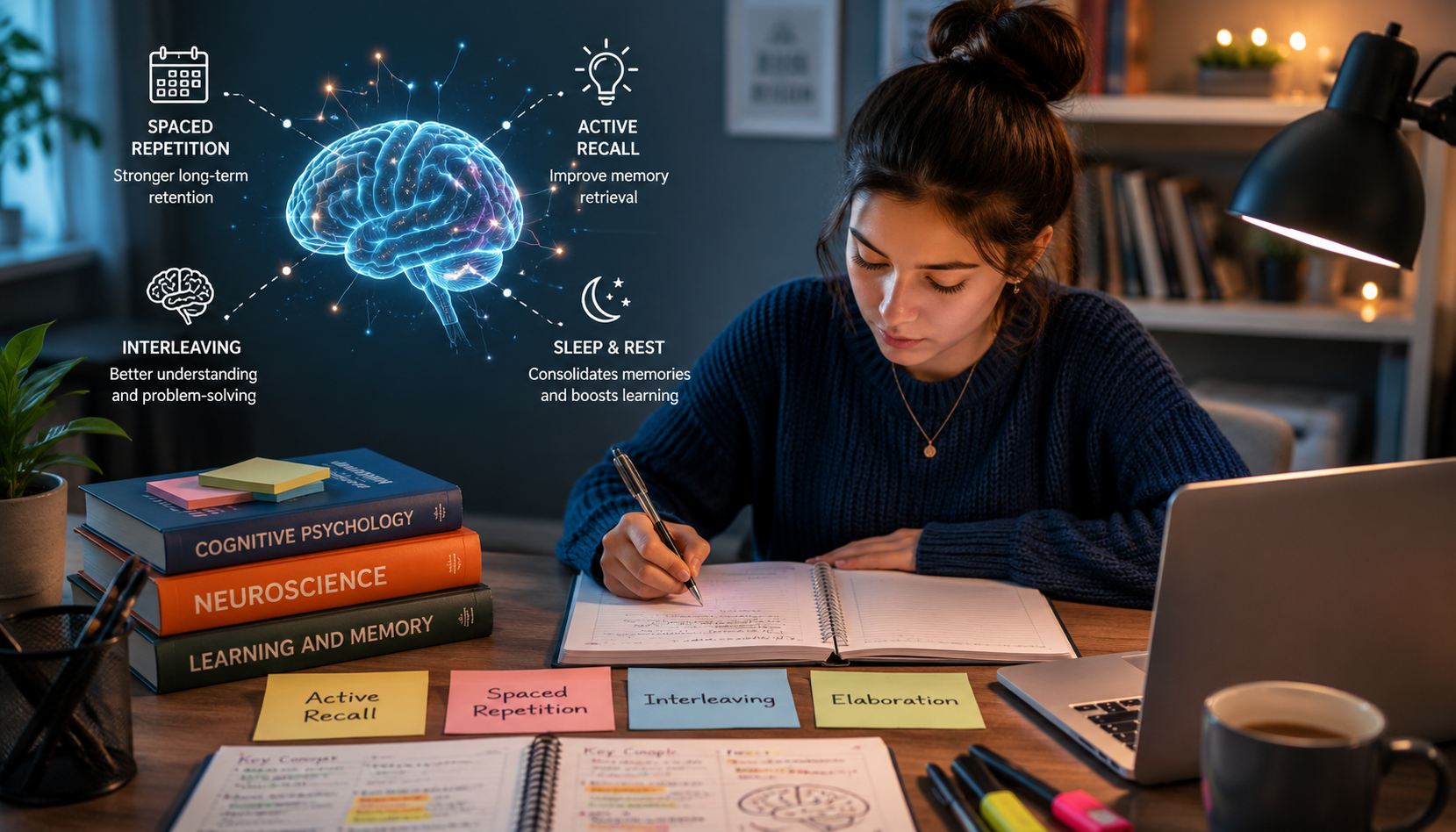
Best Study Techniques Backed by Neuroscience in 2026
Studying harder is no longer enough. In 2026, the students getting top grades are the ones studying smarter — using neuroscience-backed methods that improve memory, focus, and long-term retention.
If you have ever spent hours reading notes only to forget everything during an exam, you are not alone. Many college students rely on ineffective habits like rereading, highlighting, or cramming because they feel productive in the moment. Unfortunately, neuroscience shows that these methods often create the illusion of learning rather than real understanding.
The good news is that researchers now understand how the brain actually learns. When students use evidence-based study techniques, they retain information longer, reduce mental fatigue, and improve academic performance without spending endless hours studying.
9 MIN READ | 6 SECTIONS | 5 FAQS
Technique | Brain Benefit | Best For |
|---|---|---|
Active Recall | Strengthens memory retrieval pathways | Exams & quizzes |
Spaced Repetition | Improves long-term retention | Heavy coursework |
Interleaving | Enhances problem-solving flexibility | Math & science courses |
Why Most Students Study Inefficiently
One of the biggest academic myths is that more study time automatically equals better grades. In reality, the brain does not learn based on time alone. It learns through repetition, retrieval, emotion, sleep quality, attention, and cognitive engagement.
According to research from Harvard Graduate School of Education and cognitive science studies, passive learning techniques such as rereading notes or highlighting text create familiarity, not mastery. Students may recognize information visually but struggle to recall it independently during exams.
That explains why many students experience this frustrating cycle:
“I studied for hours, but once the test started, my mind went blank.”
The problem is not always intelligence or effort. Often, it is the study strategy itself.
The Neuroscience of Learning and Memory
Your brain strengthens information through neural connections. The more often information is retrieved and applied, the stronger those neural pathways become.
Neuroscientists explain that memory consolidation happens when the brain repeatedly accesses information over time. This is why active learning techniques outperform passive review.
There are three major stages involved in learning:
Encoding: Taking in information for the first time
Storage: Organizing information in memory
Retrieval: Accessing information later
Most students focus only on encoding by rereading notes repeatedly. However, retrieval practice is where stronger learning actually happens.
The Anatomy of High-Performance Studying
1. Active Recall: The Most Powerful Study Method
Active recall means forcing your brain to retrieve information without looking at the answer first. Instead of rereading notes, you test yourself repeatedly.
Examples include:
Using flashcards
Answering practice questions
Writing summaries from memory
Teaching concepts aloud
Using self-quizzing apps
Research consistently shows that retrieval practice improves long-term memory significantly more than passive review methods.
Bad Way vs. Pro Way
Bad Way | Pro Way |
|---|---|
Reading notes repeatedly | Testing yourself without notes |
Highlighting entire chapters | Creating active recall questions |
Watching lectures passively | Explaining concepts aloud afterward |
2. Spaced Repetition: Stop Cramming
Spaced repetition involves reviewing information over increasing intervals instead of cramming everything at once.
For example:
Review material after 1 day
Review again after 3 days
Review after 1 week
Review after 2 weeks
This technique works because forgetting is part of learning. Every time your brain struggles to retrieve information again, the memory pathway becomes stronger.
Apps like Anki and Quizlet use spaced repetition systems because they align with how memory consolidation works neurologically.
3. Interleaving: Mix Subjects Strategically
Interleaving means mixing related topics during study sessions instead of studying one topic for hours straight.
Instead of:
2 hours of biology only
Try:
45 minutes biology
45 minutes chemistry
45 minutes psychology
Research suggests that interleaving improves pattern recognition, adaptability, and deeper understanding. This is especially effective for STEM courses and problem-solving subjects.
A 4-Step Neuroscience Study Roadmap
Step 1: Study in Short Cognitive Sprints
The brain focuses better in short, intense sessions rather than marathon study blocks.
Try the Pomodoro structure:
25–45 minutes focused work
5–10 minute break
Repeat
This helps reduce cognitive fatigue while maintaining attention quality.
Step 2: Sleep Like It Affects Your GPA — Because It Does
Sleep is not optional for learning. During sleep, the brain consolidates memories and strengthens neural pathways formed during studying.
Students who sacrifice sleep for cramming often perform worse despite studying longer.
According to the CDC, insufficient sleep negatively affects concentration, memory, mood, and learning efficiency.
Step 3: Use Dopamine Strategically
The brain responds strongly to rewards and novelty. Small rewards after study sessions can improve consistency.
Examples include:
Listening to music after finishing tasks
Taking short walks
Checking social media only after study blocks
Tracking progress visually
Motivation increases when the brain associates studying with progress rather than punishment.
Step 4: Eliminate Cognitive Distractions
Multitasking damages focus quality. Neuroscience research shows task-switching increases mental fatigue and decreases retention.
Common productivity killers include:
Phone notifications
Studying with television
Constant app switching
Multiple tabs open
Background distractions
Deep focus produces stronger learning than fragmented attention.
💡 Pro-Tip for 2026: Your Brain Learns Through Struggle
Many students avoid difficult study methods because they feel uncomfortable. Ironically, the discomfort is often proof that learning is happening.
When active recall feels hard, your brain is strengthening retrieval pathways. When spaced repetition feels repetitive, your memory is becoming durable.
The most effective studying rarely feels easy in the moment.
Easy studying creates weak memory. Challenging retrieval creates strong memory.
Student Scenario: From Burnout to Better Grades
Imagine a college student preparing for finals using traditional methodus. They reread lecture slides for six hours nightly, sleep poorly, and still struggle during exams.
After switching to neuroscience-based studying, they begin:
Using active recall flashcards
Studying in focused Pomodoro sessions
Reviewing material with spaced repetition
Sleeping consistently
Reducing distractions
Within weeks, studying becomes more efficient. Instead of feeling overwhelmed constantly, they retain information faster and experience less academic burnout.
“I stopped studying longer and started studying smarter. That changed everything.”
Common Mistakes That Hurt Memory Retention
Cramming the night before exams
Highlighting entire textbooks
Passive reading without testing
Studying while scrolling social media
Skipping sleep before exams
Studying for extremely long sessions without breaks
These habits feel productive temporarily but often weaken long-term retention.
Frequently Asked Questions (FAQs)
What is the best study technique according to neuroscience?
Active recall is widely considered one of the most effective study methods because it strengthens memory retrieval pathways through repeated testing.
Why is cramming ineffective?
Cramming overloads short-term memory without allowing enough time for long-term consolidation. Students may remember information briefly but forget it quickly afterward.
How long should a study session be?
Most students perform best with focused study sessions lasting 25–45 minutes followed by short breaks.
Does sleep really improve studying?
Yes. Sleep helps consolidate memories, improve concentration, and strengthen learning pathways in the brain.
What study method works best for difficult courses?
Combining active recall, spaced repetition, and interleaving is highly effective for difficult subjects such as nursing, biology, chemistry, and mathematics.
Final Thoughts
The best study techniques for college students are not based on motivation hacks or social media trends. They are based on how the brain actually learns.
Students who use neuroscience-backed methods like active recall, spaced repetition, focused study sessions, and proper sleep often achieve better results with less stress and burnout.
In 2026, academic success is no longer about studying endlessly. It is about understanding how learning works and using strategies that align with your brain.
Feeling overwhelmed with assignments, exams, or online classes? Our academic experts at WritersHubUS help students stay ahead with professional academic support, study guidance, and coursework assistance. Get started today →
References
Brown, P. C., Roediger, H. L., & McDaniel, M. A. (2014). Make it stick: The science of successful learning. Harvard University Press.
Centers for Disease Control and Prevention. (2025). Sleep and student performance. CDC.gov.
Harvard Graduate School of Education. (2024). Effective learning strategies for students.
Dunlosky, J., Rawson, K., Marsh, E., Nathan, M., & Willingham, D. (2013). Improving students’ learning with effective learning techniques. Psychological Science in the Public Interest, 14(1), 4–58.
Pew Research Center. (2025). Student stress and digital distraction trends.