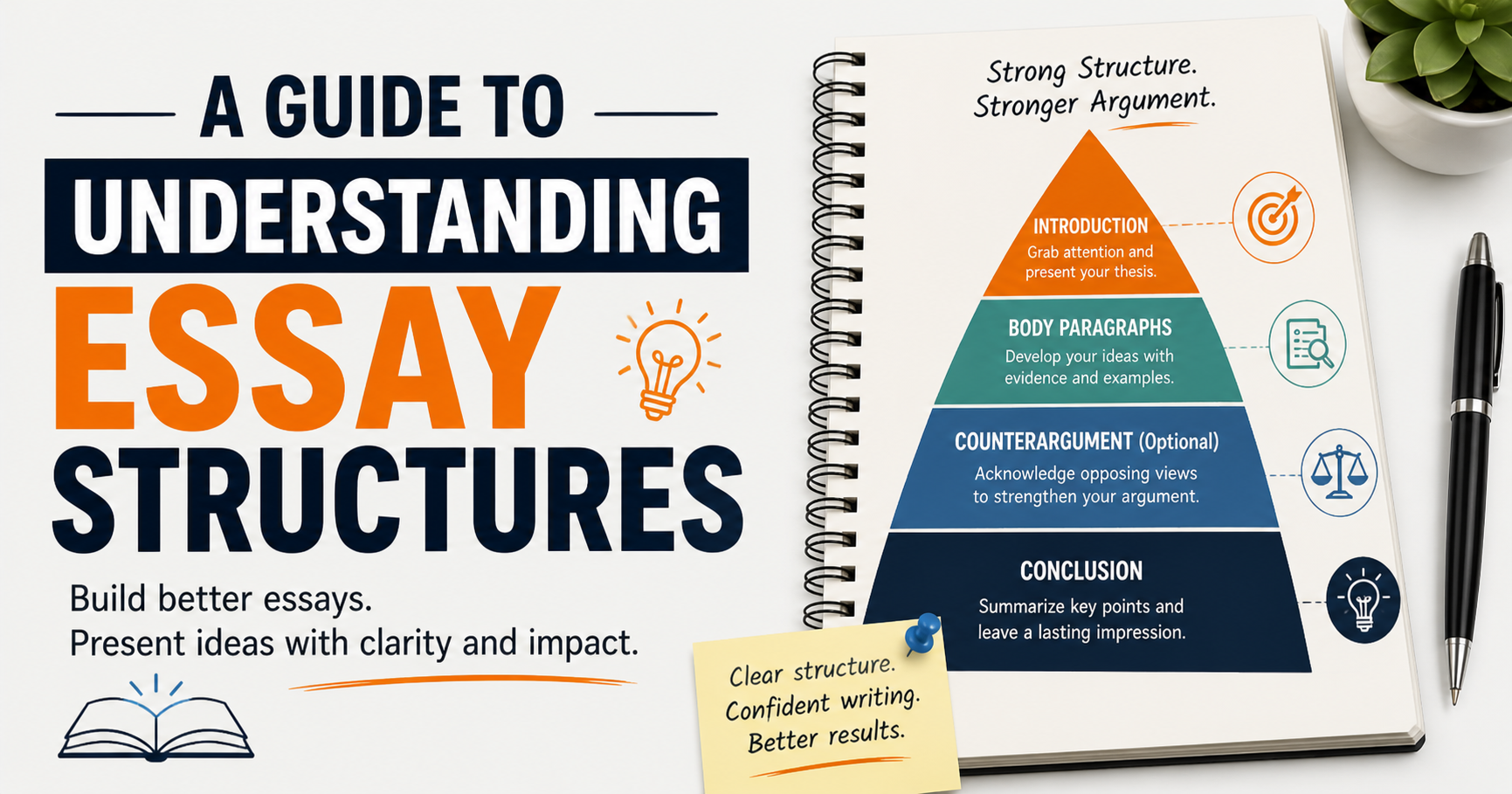
ESSAY WRITING 101
Master Your Writing: A Guide to Essay Structures
Learn the frameworks that transform good ideas into great academic papers.
A brilliant argument can fall flat without a solid framework to support it. Understanding the architecture of an essay is the first step toward crafting a compelling and persuasive piece of writing.
Every strong essay, regardless of its topic, relies on a logical structure to present its ideas clearly and effectively. This structure acts as a roadmap for the reader, guiding them through your argument or narrative from the introduction to the conclusion. Without this deliberate organization, even the most insightful points can get lost, leaving your reader confused and unconvinced. Mastering a few common essay formats provides the tools you need to build compelling papers for any academic challenge.
Think of essay structures as the foundational blueprint for your writing. Just as an architect needs a plan before construction begins, a writer needs a structural outline before drafting their prose. By learning to identify and implement the right structure for your purpose—whether it’s to persuade, inform, narrate, or describe—you gain a significant advantage in communicating your ideas with power and precision, ultimately leading to better academic outcomes.
45%
of students struggle with organizing ideas
3x
More likely to get a higher grade with a clear structure
5+
Common essay types every student should know
The Foundation: Argumentative vs. Expository Essays
Two of the most common essay types you'll encounter in academia are the argumentative and expository essays. The argumentative essay is designed to persuade the reader to accept a specific point of view or to take a particular action. A successful argumentative essay presents a clear, debatable claim (the thesis) and supports it with credible evidence, logical reasoning, and well-structured body paragraphs. A key component is addressing counterclaims—acknowledging opposing viewpoints and then refuting them (rebuttal)—which demonstrates critical thinking and strengthens your position.
The expository essay, on the other hand, aims to inform, explain, or clarify a topic. Unlike the argumentative essay, it does not try to persuade the reader but rather to provide a balanced and objective overview. The structure typically involves an introduction that presents a clear thesis statement, followed by body paragraphs that each explore a different facet of the topic with facts, statistics, and examples. Clarity and logical progression are paramount, as the primary goal is to help the reader understand the subject matter comprehensively and without bias.
The Core Difference: Argumentative essays aim to *persuade* the reader of a specific viewpoint, while expository essays aim to *inform* the reader about a topic without taking a stance.
Feeling Overwhelmed by an Assignment?
Our expert writers can help you structure and write any essay.
Crafting Stories and Scenes: Narrative & Descriptive Essays
Beyond argumentation and exposition, academic writing often allows for more creative expression through narrative and descriptive essays. The narrative essay tells a story, typically from the author's personal experience. Its structure follows a classic story arc, including an introduction that sets the scene, rising action that builds tension, a climax that marks the story's turning point, and a resolution that provides closure and reflects on the story's significance or moral. This format allows you to connect with the reader on an emotional level and is often used in application essays and creative writing courses.
The descriptive essay focuses on painting a vivid picture of a person, place, object, or event using rich sensory details. The goal is to make the reader feel as if they are experiencing the subject firsthand. While it can have a narrative quality, its primary structure is organized around sensory information—sight, sound, smell, taste, and touch. The organization can be spatial (top to bottom, near to far) or chronological, but the emphasis is always on creating a specific mood or impression rather than telling a sequential story or arguing a point.
✓
Clarity of Thought
A good structure ensures your ideas are presented logically and are easy for the reader to follow.
★
Stronger Arguments
Proper organization allows you to build a more persuasive case, with evidence supporting your claims effectively.
⏱
Faster Writing
Knowing your structure beforehand acts as a roadmap, saving you time during the drafting process.
✎
Improved Grades
Professors value well-structured essays, as they demonstrate critical thinking and a clear understanding of the material.
The Analytical Lens: Compare & Contrast and Cause & Effect
For deeper analytical tasks, the compare and contrast and cause and effect structures are essential. A compare and contrast essay examines the similarities and differences between two or more subjects. There are two primary ways to structure it: the block method, where you discuss everything about one subject first and then everything about the second subject, or the point-by-point method, where you discuss one point of comparison for both subjects, then a second point, and so on. The latter is often more effective for longer essays as it keeps the comparison direct and engaging.
A cause and effect essay explores the relationship between events, explaining why something happened (causes) and what its consequences were (effects). This structure is crucial in history, social sciences, and natural sciences. You can structure it by focusing first on a single cause and its multiple effects, or by exploring multiple causes that lead to a single effect. The key is to demonstrate a clear, logical connection between the causes and effects you are analyzing, supported by evidence and specific examples.
"I always struggled to organize my thoughts for my history papers. Learning the compare and contrast structure from WritersHubUS was a game-changer. My last essay was my best yet!"
— Erick, University Student
Ready to Build a Better Essay?
From outlines to final drafts, we provide the support you need.
Our Simple Process for Essay Success
1
Submit Your Requirements
Tell us about your essay topic, required structure, and deadline.
2
Match with an Expert
We connect you with a professional writer who specializes in your subject area.
3
Collaborate & Review
Receive a structured draft and provide feedback for any necessary revisions.
4
Receive Your Final Paper
Get a polished, publish-ready essay that meets all your requirements.
Putting It All Together: The Five-Paragraph Model
Perhaps the most well-known framework is the classic five-paragraph essay. This model serves as an excellent starting point for writers learning to structure their thoughts. It consists of an introduction containing a compelling hook and a clear thesis statement, three body paragraphs that each focus on a single piece of evidence supporting the thesis, and a conclusion that summarizes the main points and restates the thesis in a new light. Each body paragraph should have its own topic sentence, supporting details, and a concluding sentence that transitions to the next point. This rigid structure provides a simple, effective way to ensure your essay is balanced and easy to follow.
Beyond the Basics: While the five-paragraph model is a great starting point, complex topics may require more developed structures. Use it as a foundation to build upon, not a rigid constraint.
Stop Stressing, Start Writing with Confidence.
Let our experts help you craft a perfectly structured essay that gets results.