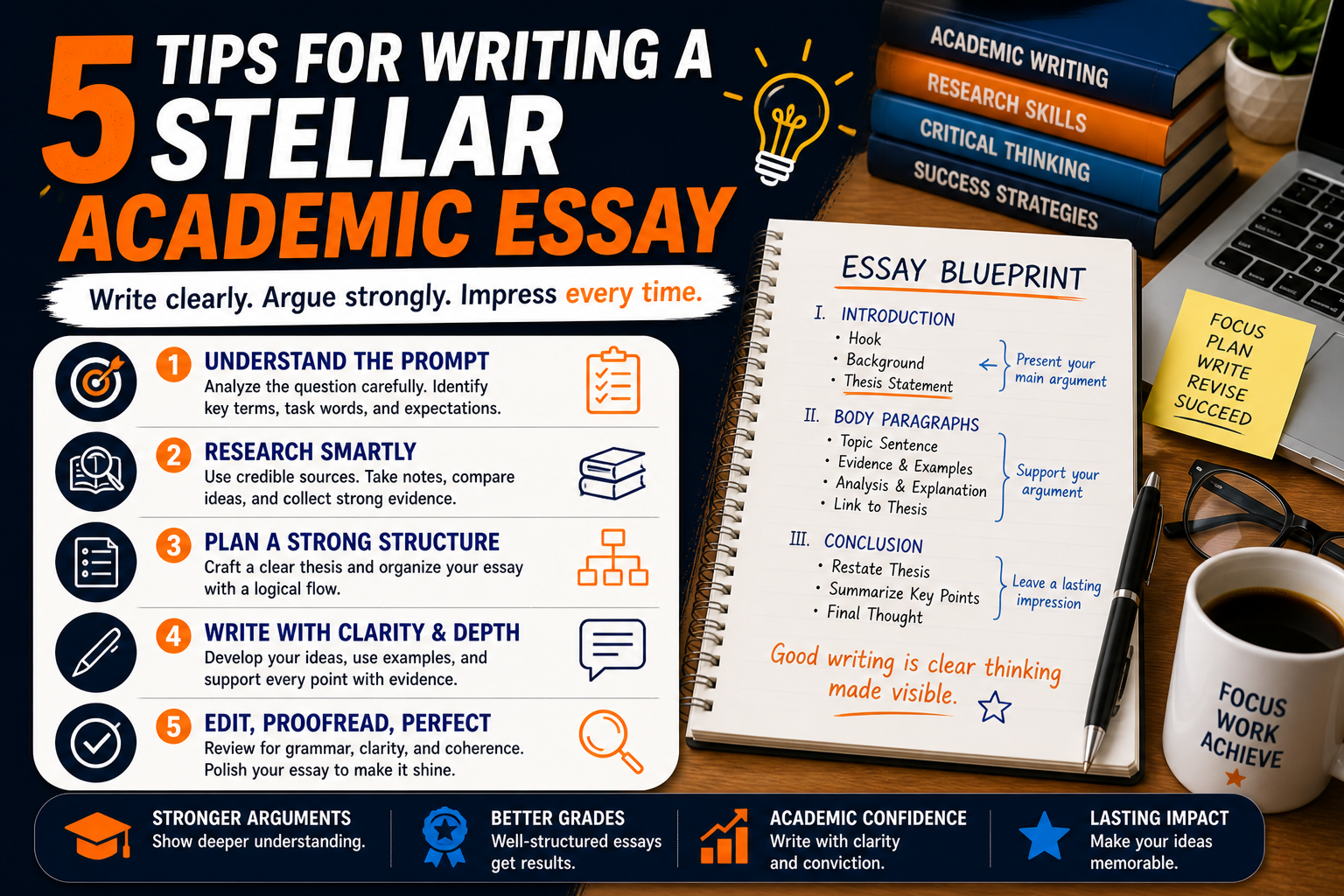
Writing a high-quality academic essay can feel like navigating a maze without a map. These five core strategies provide a clear path to success, helping you structure your arguments, strengthen your research, and polish your final draft.
Academic writing is a skill, and like any skill, it can be learned, practiced, and mastered. Many students struggle not because they lack intelligence, but because they haven't been taught the fundamental mechanics of crafting a persuasive, well-structured essay. Common pitfalls include weak thesis statements, disorganized arguments, insufficient evidence, and sloppy proofreading. These issues can turn a potentially insightful paper into a confusing one, often resulting in a grade that doesn't reflect the student's true understanding of the material.
The good news is that a systematic approach can solve these problems. By focusing on five key areas—understanding the prompt, conducting thorough research, crafting a strong thesis, writing with clarity, and meticulous editing—you can build a repeatable process for success. Think of these tips as your framework for academic excellence, designed to bring structure and confidence to your writing process, from the first word to the last.
1. Deconstruct the Prompt & Build Your Roadmap
Before you write a single word, you must fully understand what the essay prompt is asking. Many students skim the question and miss critical details, leading them to write an excellent essay on the wrong topic. Take the time to dissect the prompt: identify the keywords (e.g., "analyze," "compare," "argue"), the core concepts, and any constraints on scope or length. What question are you truly being asked to answer? Underline key phrases and rephrase the prompt in your own words to ensure you’ve grasped its core requirement.
Once you understand the task, create a detailed outline. This is your architectural blueprint, and skipping this step is a recipe for a disorganized paper. Start with a basic structure: introduction, body paragraphs (one for each main point), and conclusion. Then, flesh it out. For each body paragraph, write a topic sentence that presents a mini-argument, and list the specific evidence or examples you plan to use to support it. A robust outline keeps your writing focused and ensures your argument progresses logically from one point to the next.
Blueprint for Success: Your outline isn't just a suggestion; it's the architectural plan for your essay. A detailed outline prevents writer's block and ensures every paragraph serves a clear purpose in supporting your main argument.
2. Conduct Deep and Credible Research
A strong academic essay is built on a foundation of credible evidence. This means moving beyond simple web searches and diving into academic databases. Your university library provides access to invaluable resources like JSTOR, ProQuest, Google Scholar, and other field-specific journals. These platforms contain peer-reviewed articles, scholarly books, and primary sources that provide the depth and authority your paper needs. When researching, use keywords from your essay prompt to guide your search, but also be open to following citations and exploring related topics to broaden your understanding.
As you gather sources, practice critical evaluation. Not all information is created equal. For each source, ask: Is the author a recognized expert in their field? Is the publication reputable? Is the information up-to-date and relevant to your topic? Keep meticulous notes and manage your citations from the very beginning. Using a reference manager like Zotero or EndNote can save you hours of work later and help you avoid accidental plagiarism by keeping all your source information in one organized place.
3. Forge a Strong, Arguable Thesis Statement
The thesis statement is the single most important sentence in your essay. It is the central pillar around which your entire paper is built. A thesis is not a statement of fact or a summary of a topic; it is a clear, concise, and arguable claim that you will spend the rest of the essay proving. It should appear at the end of your introduction and offer a specific argument that answers the main essay question. A weak thesis might say, "This paper will discuss the causes of the American Revolution." A strong thesis would argue, "The American Revolution was caused not just by opposition to taxation, but by a deeper ideological conflict over legal and political self-determination."
To craft a strong thesis, ensure it is both specific and debatable. It should be narrow enough to be covered adequately in the space of your essay, and it must present a viewpoint that a reasonable person could disagree with. Your thesis is your promise to the reader, setting their expectations for the argument to come. As you write, constantly refer back to your thesis. Does each paragraph directly support this central claim? If not, you either need to revise the paragraph to connect it to your thesis or refine the thesis itself to accommodate your new line of reasoning.
"I was completely stuck on my history dissertation. The writer I worked with not only understood the topic deeply but also helped me structure my arguments in a way I hadn't considered. The final paper was clear, compelling, and earned me a top grade."
How It Works: Our Simple Writing Process
4. Write with Clarity, Cohesion, and Structure
With your outline and thesis in hand, the writing process becomes much more manageable. Each body paragraph should function as a mini-essay, focused on proving a single point that supports your overall thesis. Follow the "PIE" structure: Point, Illustration, Explanation. Start with a clear topic sentence (Point) that introduces the paragraph’s main idea. Then, provide your evidence (Illustration), such as a quote, statistic, or data point from your research. Crucially, you must then explain how this evidence proves your point (Explanation). This analysis is what demonstrates your critical thinking. Finally, use transition words and phrases to create a smooth link to the next paragraph, guiding the reader through your train of thought.
The Flow Factor: Smooth transitions between paragraphs are crucial. They guide the reader through your logic, making your argument feel seamless and persuasive rather than a collection of disconnected points.
5. Edit and Proofread Meticulously
Never submit your first draft. A great essay is forged in the revision process. It’s essential to distinguish between editing and proofreading. Editing is about the big picture: Is your argument coherent? Does your evidence sufficiently support your thesis? Is the structure logical? Does each paragraph flow smoothly to the next? Step away from your essay for a day or two to gain a fresh perspective. When you return, read it with a critical eye, focusing on strengthening the overall argument and clarity of your claims.
Proofreading is the final, crucial step. This is where you hunt for surface-level errors: spelling mistakes, grammatical errors, typos, and formatting issues. Reading your essay aloud is one of the most effective ways to catch awkward phrasing and errors you might otherwise miss. Use grammar and spelling checkers as a first pass, but don’t rely on them entirely—they can miss context-specific mistakes. If possible, have a friend or colleague read it over. A fresh pair of eyes can spot errors you’ve become blind to, ensuring your final submission is polished and professional.
Ready to Achieve Academic Excellence?
Let our top-tier writers deliver a custom, high-quality essay that meets your exact requirements. Your A+ paper is just a few clicks away.